
The present age is an age of contradictions. On the one hand, there is an information explosion, and on the other, our mental faculties seem increasingly lost in the din. “As differences between fact and opinion, real and fake lose clarity, truth becomes relativised, and we are told we live in a “post-fact” world” (Loseke, 2018, p. 1). The emergence of the Internet and the World Wide Web and the development of social media later have played a significant role in the process. When the most basic facts are contested and their meanings deliberately altered, it is the democratic institutions and their legitimacy that suffer, giving way to “partisan political combat” in every domain of life (Fukuyama, 2017).
As our belief in “truth” recedes, our belief in emotions increases. “We often worry more about how we feel than about how we think; we often feel the emotions of distrust, anger, and fear and direct our reactions to institutions and their representatives, to social change, to strangers living among us” (Loseke, 2018, p. 2).
In a “post-fact” world, emotions and beliefs overshadow factual accuracy, where people go by what feels true rather than what can be proven true. The phenomenon is not limited to one country but instead characterises politics across countries, be that the 2016 US elections or the UK’s Leave Campaign (ECPS, n.d.) and other contemporary political contexts in which competing narratives seek to establish what should count as credible knowledge. One reason that can be attributed to it is the explanation that, in an ever-increasing informational chaos, we make sense of social problems through stories or narratives that help us contextualise events and characters in an otherwise meaningless world. Stories and narratives appeal to our sentiments and speak to questions of morality that are pivotal to human existence, since they tell us who should be valued and who should be despised. As the world becomes more globalised, fragmented, and mass-mediated, how do we make sense of the stories and narratives presented to us? And of what is said, and what remains unsaid? How do we make sense of what law and justice should be? (Loseke, 2018). In other words, how do we make meaning of meaning? And what role do the politics of omission and commission play in this interpretation (hermeneutics) of meaning? This is what I seek to examine in this article.
In today’s “post-fact” world, we do not encounter words as just words. Words arrive already surrounded by narratives, affects, histories and political claims. The politics of meaning often overshadows what is said, which creates a fog focused on power, ideology, propaganda or hyper-partisan spin. In such moments, turning to hermeneutics – the method or the “how”, of making sense of meaning can help us pierce through this fog. Yet interpretation itself is not innocent. Meaning can be altered not only through what is added to an utterance, but also through what is removed from it. What is omitted can make certain interpretations possible; what is commissioned can make them politically powerful. Hermeneutics, however, does not offer a neutral escape from politics. It asks us to examine the conditions through which meaning is produced, understood and contested. Here I take the Indian case of the use of the word “cockroach” in a courtroom observation by the Chief Justice of India (CJI) and its inference as a comparison of the country’s youth to cockroaches as an empirical case to look into the questions posed above.
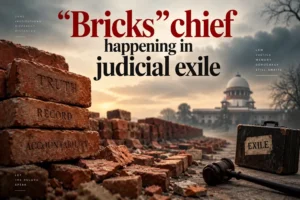
During a Supreme Court hearing on 15 May 2026, in the context of concerns about fraudulent law degrees and the integrity of the legal profession, the CJI used the metaphor of “cockroaches” while referring to unemployed youngsters whom he associated with becoming media persons, social-media influencers and RTI activists and with attacking the system. The remarks generated controversy and were followed by a clarification that they were directed at persons who had entered the legal profession through fake or bogus degrees, rather than Indian youth generally. The distinction between what was uttered and what was subsequently clarified is crucial to the argument of this article. For the controversy did not end with clarification. Instead, the word escaped its original institutional setting and acquired a second political life. The “Cockroach Janta Party” emerged as a satirical appropriation of the metaphor, turning an institutional designation into a political identity. What had been uttered in the course of a judicial proceeding became, through circulation and appropriation, a badge of dissent. (Sanjay Dubey v. Registrar General, High Court of Delhi, MA No. 1297/2026; Ananthkrishnan, 2026; PTI, 2026). The episode therefore raises questions more profound than whether the CJI was “misquoted” or whether the public “misunderstood” him: how are we to make sense of what was (un)said? Who has the authority to determine what an institutional utterance means once it enters the public sphere? And what are the limits of such interpretation?
Scholars have long debated how words and texts should be interpreted, and the question of meaning is as much a philosophical question as it is a political one. Before asking who controls meaning, one must ask where meaning resides in the first place. Does it reside in the intention of the speaker, in the words themselves, in the historical context in which they are spoken, in the reader who encounters them, or somewhere between the speaker, the text and the world in which it is received? The different traditions of hermeneutics answer this question differently. It is this philosophical disagreement over the location and limits of meaning that provides the analytical frame through which I examine the politics of omission and commission.
The intentionalist tradition, represented particularly by E. D. Hirsch (1967), argues that interpretation should seek to recover the author’s intended meaning. For Hirsch, interpretation must distinguish between what an author meant and what a text may subsequently mean to different readers. Meaning, in this sense, is not infinitely open. It has an authorial centre that interpretation must attempt to recover. The attraction of intentionalism for institutional speech is evident. If an institutional actor says something within a particular setting, then what the actor intended to communicate, and the context within which that communication occurred, cannot simply be discarded by subsequent audiences. Meaning has an origin, and that origin matters.
Yet intentionalism also raises a difficulty. What happens when an utterance produces meanings that its author did not intend? Can intention exhaust the political life of a word? The problem becomes particularly acute when the speaker is an institution whose words carry authority beyond the immediate circumstances of their utterance. An institution may intend one meaning, while its words generate another. The question then shifts from what the speaker meant to what the speech act has come to mean.
Quentin Skinner (1969) and J.G.A. Pocock (2009), associated with the Cambridge School, directed attention from texts as repositories of timeless ideas to political language as historically situated discourse. Skinner asks what an author was doing in saying something within a particular linguistic and historical context, while Pocock directs attention to the political languages and discursive conventions within which political actors formulate and contest meaning. Skinner’s intervention is important because he does not treat political texts as timeless containers of ideas. To understand an utterance is to understand what its author was doing in saying it, within a particular linguistic and historical context. Words are therefore not merely expressions; they are acts. To say something is also to accuse, justify, warn, persuade, condemn, defend or authorise something. Meaning consequently cannot be separated from the conventions that made a particular speech act intelligible at that moment (see Skinner, 1969; Pocock, 2009).
This is particularly significant for institutional speech. A courtroom observation is not simply a sentence uttered by an individual. It is an utterance embedded within a legal proceeding, a professional vocabulary, a hierarchy of authority and a particular institutional purpose. To remove it entirely from that context is therefore to alter the conditions under which its meaning can be understood. The Skinnerian question—“What was the speaker doing in saying this?”—becomes indispensable to the politics of omission because omission may remove precisely those contextual conditions that make an utterance intelligible.
But contextualism also cannot provide a complete answer. The historical context of utterance is not necessarily the only context in which meaning exists. Words travel beyond the moment of their utterance. The context in which a word is spoken may not be the context in which it is heard, circulated or politically appropriated. The meaning of an utterance therefore begins with intention and context, but may not end there.
Scholars promoting the hermeneutics of suspicion—Marx, Freud and Nietzsche—take the argument in another direction (see Ricoeur, 1970). Rather than accepting the literal or stated meaning of words, they ask readers to look beyond them to uncover hidden power structures, ideological interests and subconscious biases. The hermeneutics of suspicion introduces a fundamentally different question: not “What does this mean?” but “What does this meaning conceal?” Meaning is no longer taken at face value. What appears as neutral may conceal power; what appears as natural may be historically produced; what appears as intention may itself be shaped by forces of which the speaker is unaware.
This tradition is crucial to understanding omission. If intentionalism asks us to recover what was present, suspicion asks us to look for what has been concealed. It shifts the analytical gaze from the spoken to the unspoken, from presence to absence. Marx asks us to look for ideology beneath apparently neutral forms; Freud for the unconscious beneath conscious expression; Nietzsche for the relations of power and valuation beneath claims to truth. Meaning thus becomes a site of excavation.
Yet the hermeneutics of suspicion also contains a danger for the politics of meaning. If every statement is treated primarily as a symptom of an underlying power structure, interpretation can become detached from the object it seeks to understand. The interpreter begins to discover what the text “really” means beneath what it says, and the literal object gradually disappears beneath its symbolic reconstruction.
In “Against Interpretation,” Sontag mounted a broader critique of interpretive excess, particularly interpretations that subordinate the work itself to an imposed conceptual meaning. Sontag argued that interpretation can deplete the world to create a “shadow world of “meanings”” (Sontag, 1966, p. 7). A thing is a thing and not what is said of that thing, she suggests, and the danger of interpretive excess acquires particular importance in an age in which every event is rapidly transformed into a sign of something else. For Sontag, interpretation can become so powerful that it replaces the thing itself. Instead of encountering the event, we encounter its interpretation, and instead of the object, its symbolic representation.
Sontag therefore introduces a necessary limit into hermeneutics. Not everything needs to be decoded into a deeper meaning. Sometimes what was said must first be allowed to remain what was said. This is particularly important for the present argument because the politics of omission and commission can operate through interpretive excess as much as through informational absence. Omission can remove context, but commission can add meanings that were never there. Both can produce a shadow world in which the interpretation becomes more politically consequential than the event from which it emerged.
The post-structuralists complicate the question further. Roland Barthes (1967, 1977) argues that meaning is radically unstable and cannot remain permanently secured by the author. In “The Death of the Author,” the author ceases to be the final sovereign of meaning once the text enters the world of readers. The text becomes a space of multiple voices, references and interpretations, and its meaning is produced through reading rather than simply recovered from the consciousness of its creator. Supporting the argument, Barthes writes, “The reader is the space on which all the quotations that make up a writing are inscribed without any of them being lost; a text’s unity lies not in its origin but in its destination” (Barthes, 1977, p. 148).
Barthes therefore marks a decisive movement from the question of intention to the question of reception. If Hirsch asks us to return to the author, Barthes asks us to move away from the author. The meaning of a word is no longer guaranteed by the person who uttered it. Once spoken, it enters other worlds of experience and association. The audience does not merely receive meaning; it rather participates in producing it.
This becomes politically significant when the audience is not passive but organised, affective and resistant. A word spoken from a position of authority can be appropriated by those who experience themselves as its objects. It can be repeated ironically, transformed into satire, converted into identity and returned to the institution that produced it. The “cockroach” therefore illustrates the Barthesian moment particularly well: the word acquires a second life beyond the intention of the speaker.
Yet “the death of the author” cannot mean the death of context. If authorial intention is insufficient to determine meaning, neither does every possible interpretation become equally valid. To say that meaning is unstable is not necessarily to say that meaning is arbitrary. This is where philosophical hermeneutics, particularly Hans-Georg Gadamer, provides a crucial bridge.
For Gadamer (1989, 2004), once a word is spoken or written, it enters the public sphere and no longer belongs entirely to the author. Understanding emerges through a “fusion of horizons”, that is, an encounter between the text and the current reality of the audience. Understanding is therefore neither the recovery of an original intention nor the free invention of a reader. It is an encounter between horizons: the horizon from which the utterance emerges and the horizon from which it is interpreted. Meaning happens in this encounter since “understanding is never a subjective relation to a given “object” but to the history of its effect; in other words, understanding belongs to the being of that which is understood” (p. xxviii).
Gadamer is particularly useful for understanding why the same word can acquire different meanings at different historical moments without reducing those meanings to mere distortion. The audience brings its own experiences, anxieties, historical circumstances and expectations to the act of interpretation. A word spoken in a courtroom may therefore encounter, once circulated publicly, a very different social horizon – one marked by unemployment, examination scandals, economic precarity, generational anxiety and distrust of institutions. The word has not necessarily changed lexically; the horizon against which it is understood has changed.
This allows us to move beyond the binary between “what the speaker meant” and “what the audience understood.” Meaning is neither entirely inside the speaker nor entirely inside the audience. It emerges relationally. But this relationality also makes meaning politically vulnerable, because horizons do not meet under conditions of equality. Some speakers possess greater institutional authority, some audiences possess greater communicative reach, and some interpretations are amplified more rapidly than others.
Taken together, these traditions produce a philosophical tension rather than a single theory of meaning. Meaning is at once intended, situated, concealed, interpreted, appropriated and negotiated. It has an origin but not necessarily a single destination.
It is within this tension that I locate the politics of omission and commission. Omission operates when the conditions necessary for one horizon of understanding are removed. Commission operates when a new horizon actively supplies meanings, associations or political claims to an utterance. Omission can therefore make a meaning possible by removing what would complicate it; commission can make a meaning powerful by adding what was not originally there.
The question is consequently not whether one should choose intention over reception, or context over interpretation. The question is what happens in the movement between them. What is retained from the original utterance? What is removed? What is added? Who does the removing? Who does the adding? Which interpretation acquires authority, and through what institutional or technological power?
In the post-fact world, hermeneutics has therefore become an active battlefield, where, rather than a tool to discover meaning or simply understand it, it has become a means through which actors seek to assert control over meaning through omissions and commissions.
The struggle is no longer merely over what a text means. It is over the conditions under which something comes to mean. Meaning becomes political not only because different actors interpret the same event differently, but because actors possess unequal capacities to select, circulate, amplify and legitimise particular interpretations. The politics of meaning is thus also a politics of visibility: of what can be seen, what must remain unseen, what can be heard, what is silenced, and what becomes sayable.
The “cockroach” controversy can be read through precisely this philosophical problem. An intentionalist reading asks what the CJI meant. A contextualist reading asks what he was doing in the courtroom and what institutional problem he was addressing. A hermeneutics of suspicion asks what the metaphor reveals about institutional power and hierarchy. A Sontagian reading asks whether the metaphor has become so symbolically overloaded that the underlying issue of fraudulent qualifications has disappeared. A Barthesian reading asks what happens when the word is detached from its author and appropriated by its audience. A Gadamerian reading asks how the word encounters a new horizon of youth anxiety, unemployment and distrust.
None of these readings, taken alone, is sufficient. Together, however, they show that the controversy is not simply about a word. It is about the movement of a word between worlds. And it is in that movement that the politics of omission and commission becomes visible.
In this context, hermeneutics can help rescue meaning from the politics surrounding it. Institutions, since they yield power, should bear a higher linguistic responsibility if they are to preserve the public trust. Institutional speakers possess unequal communicative power and hence their words carry authority and can produce material consequences. Therefore, institutional power should entail linguistic restraint. The public possesses a right to reinterpret. But reinterpretation cannot erase the conditions of interpretation. A democratic public sphere requires a minimal commitment to contextual intelligibility.
If an institution says: “I was referring to fraudulent law-degree holders,” and the public responds: “Therefore you said all unemployed Indian youth are cockroaches,” the second proposition may be politically intelligible as a critique, but it cannot automatically be treated as a faithful representation of the original statement. The distinction is subtle but essential.
One can say: “Your metaphor was dehumanising and could reasonably be received by young people as contemptuous.” That is criticism. It is different from saying: “The CJI explicitly declared all unemployed youth to be cockroaches.” That is a claim about what was actually said and therefore remains answerable to context. The first belongs to democratic interpretation. The second belongs to factual representation. The politics of meaning becomes dangerous when these categories are collapsed.
The distinction also works in the other direction. An institution cannot simply invoke its original intention and thereby close down all subsequent interpretation. The social effect of institutional speech cannot be dismissed merely because that effect was unintended. Intention matters, but so does reception. Likewise, context matters, but so does circulation. Meaning emerges in the tension between them.
We can say that while traditional hermeneutics required time, patience, and historical distance to carefully reconstruct context, the digital age has replaced this with what might be called “instant hermeneutics.” Algorithmic social media platforms slice a multi-hour court hearing into a short soundbite. The interpretation is often performed in milliseconds, fueled by existing public anger. The context is compressed, displaced or erased, and the immediate emotional impact can become the dominant frame through which the event is encountered.
“Instant hermeneutics” does not merely accelerate interpretation; it changes the conditions under which interpretation occurs by privileging the fragment over the whole and affect over deliberation. The question is no longer only how we interpret, but how quickly we are compelled to interpret.
The solution is not to return to the fantasy of a single, final meaning. Nor is it to accept that meaning is whatever a sufficiently large audience believes it to be. What is required is “hermeneutic responsibility”. “Hermeneutic responsibility” means recognising that every act of communication carries two obligations: the obligation of the speaker to provide sufficient context, and the obligation of the receiver to preserve sufficient context.
For institutions, this requires precision of language, awareness of unequal powers, sensitivity to foreseeable interpretations and a willingness to clarify without treating criticism itself as illegitimate. For publics, journalists and digital platforms, it requires preservation of relevant context, distinction between quotation and interpretation, resistance to algorithmically rewarded outrage and willingness to acknowledge when a political interpretation exceeds the original evidence.
These obligations are not identical because communicative power is not equally distributed. Institutions speak from positions of authority; publics often speak from positions of reception and resistance. The obligation of the institution is therefore greater in the production of publicly consequential speech, while the obligation of the public, media and digital intermediaries is greater in representing and circulating that speech.
The politics of omission and commission thus reveals a deeper problem of democratic communication. The struggle is not simply between truth and falsehood, but between competing constructions of what is visible, what is absent and what is made to signify. What is omitted may be as politically consequential as what is spoken; what is commissioned into meaning may become as powerful as what was originally intended.
Perhaps, then, the politics of meaning is ultimately a politics of responsibility: responsibility for what is said, responsibility for what is left unsaid, and responsibility for what is subsequently made to mean. In an age of “instant hermeneutics”, the democratic task is not to find one final meaning, but to preserve the conditions under which meanings can be contested without allowing either omission or commission to become a substitute for context.
References:
Barthes, Roland. 1977 [1967]. “The Death of the Author.” In Image-Music-Text, translated by Stephen Heath. New York: Hill and Wang.
European Center for Populism Studies. (n.d.). Post-truth politics. ECPS Vocabulary. ECPS: Post-Truth Politics
Fukuyama, Francis. 2017. “The Emergence of a Post-Fact World.” Project Syndicate, 12 January 2017.
Gadamer, Hans-Georg. 2004 [1975, 1989]. Truth and Method. 2nd revised edition, translated by Joel Weinsheimer and Donald G. Marshall. London and New York: Continuum.
Hirsch, E. D. 1967. Validity in Interpretation. New Haven: Yale University Press.
Loseke, Donileen R. 2018. “Narrative and the Politics of Meaning in a ‘Post-Fact’ World.” Social Problems 65 (1): 1–10. https://doi.org/10.1093/socpro/spx041.
Ricoeur, Paul. 1970. Freud and Philosophy: An Essay on Interpretation. New Haven: Yale University Press.
Skinner, Quentin. 1969. “Meaning and Understanding in the History of Ideas.” History and Theory 8 (1): 3–53. https://doi.org/10.2307/2504188
Sontag, Susan. 1966. “Against Interpretation.” In Against Interpretation and Other Essays, 3–14. New York: Farrar, Straus and Giroux.
Contemporary case sources
Sanjay Dubey v. Registrar General, High Court of Delhi, MA No. 1297/2026, Supreme Court of India (2026)
G.Ananthkrishnan. Indian Express. 2026. “CJI reiterates: Cockroach remarks only for fake law degree holders, not all youth.” 25 July 2026. https://indianexpress.com/article/legal-news/cji-reiterates-cockroach-remarks-only-for-fake-law-degree-holders-not-all-youth-10802482/
NDTV/PTI. 2026. ““I’m Pained…Was Misquoted”: Chief Justice On “Cockroaches” Remark.” 17 May 2026. https://www.ndtv.com/india-news/cockroaches-remarks-misquoted-aimed-at-fake-degree-holders-chief-justice-of-india-surya-kant-11506609