
Constitutional Apprehension, Kerala Congress and the Politics of Judicial Resignation
From the Emergency of 1975 to the courtroom satyagraha of 2026: why the Constitution asks us for evidence, restraint, dissent and memory.
The moment before the moment
Constitutional democracies rarely collapse on the day a proclamation is signed. By then, most of the damage has already been done. The more dangerous moment comes earlier, and more quietly: when those who hold power begin to treat constitutional institutions as extensions of their immediate ambitions, and when the rest of us stop noticing. India remembers 25 June 1975. But if constitutional memory is to be of any real use, it has to begin two years before that, with the struggle over judicial independence in 1973.
So the question I want to ask in October 2026 is not whether India has already slipped into another Emergency. It has not, and saying so loosely does nobody any favours. The harder question is whether we, as citizens and as lawyers, have the intellectual courage to name constitutional dangers when we see them, without turning apprehension into accusation, or political disagreement into an assault upon the judiciary.
A post, and its withdrawal
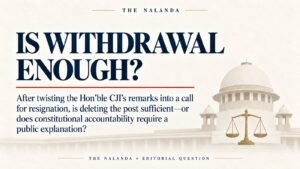
On 12 October 2026, the Kerala unit of the Indian National Congress published a social-media post demanding the resignation of Chief Justice of India Surya Kant. It went further, suggesting that the party could find a replacement. The post was deleted soon afterwards. Kerala Pradesh Congress Committee president Sunny Joseph said the message had been published without the knowledge or consent of the leadership, and the person responsible was removed from that position. Congress spokesperson Pawan Khera distanced the national party from the post and reaffirmed its faith in the judiciary.
The deletion and the disavowal are significant political developments. Neither, however, is a judicial finding of illegality, and we should resist the temptation to read them as one.
Let me say at the outset that I hold Kerala’s intellectual and political traditions in genuine regard. A state whose history is so rich in social reform, constitutional argument, literacy, political organisation and public debate has earned the right to be engaged with rather than condemned. That is precisely why this episode deserves reflection rather than collective censure.
A political party may criticise the Chief Justice. It may question a judgment, challenge an administrative decision and demand constitutional accountability. This is the ordinary business of democracy. What it cannot do is speak of “replacing” a Chief Justice as though the office were in its gift. The Constitution settles who appoints a judge of the Supreme Court in Article 124(2), and the Supreme Court has read that provision, first in Supreme Court Advocates-on-Record Assn. v. Union of India, (1993) 4 SCC 441, and again in Supreme Court Advocates-on-Record Assn. v. Union of India, (2016) 5 SCC 1, as vesting primacy in the judiciary itself, precisely so that political preference does not decide who sits on the Bench. Removal is harder still. Article 124(4) permits it only on the ground of proved misbehaviour or incapacity, through an address of both Houses of Parliament carried by special majorities, after an inquiry under the Judges (Inquiry) Act, 1968. Disagreement with the incumbent is not among the grounds. No party, in government or in opposition, possesses an independent constitutional authority to install a Chief Justice of its choosing.
1973: the supersession
Why does this distinction matter so much? Return to April 1973. The day after the Supreme Court delivered its judgment in Kesavananda Bharati v. State of Kerala, (1973) 4 SCC 225, Justice A.N. Ray was appointed Chief Justice of India in supersession of three judges senior to him: Justices J.M. Shelat, K.S. Hegde and A.N. Grover. All three had been in the majority that held Parliament could not amend away the basic structure of the Constitution. Justice Ray had been in the minority. All three resigned.
The controversy was never really about seniority as a matter of etiquette. It was about whether the executive could shape the constitutional character of the judiciary by choosing who led it, and whether judges would learn, simply by watching who was elevated and who was passed over, which kinds of judgments were rewarded.
That is why this history cannot be reduced to a gallery of personalities. The question it raises is institutional, and it outlives everyone involved: what happens when the political executive acquires, or is perceived to acquire, the capacity to reward judicial philosophies congenial to its own? The appointment was challenged before the Delhi High Court in P.L. Lakhanpal v. A.N. Ray, AIR 1975 Del 66, and the challenge did not succeed. The allegations of improper political motive were contested legal claims; they were never established as judicial findings, and honesty requires us to say so. But a petition can fail in law while the episode it describes still stands as a warning. This one does.
1976: the dissent that outlived its court
The Emergency proclaimed on 25 June 1975 then exposed, in the starkest terms, the tension between executive power, fundamental rights and judicial responsibility. In A.D.M. Jabalpur v. Shivkant Shukla, (1976) 2 SCC 521, a majority of four judges held that while the Emergency lasted, a detenu could not approach a court to enforce the right to life and personal liberty under Article 21. Justice H.R. Khanna alone disagreed. He was superseded for the office of Chief Justice the following year, and resigned.
His dissent occupies a special place in Indian constitutional thought not only because it was right, though it was, and though a nine-judge Bench eventually said so in Justice K.S. Puttaswamy (Retd.) v. Union of India, (2017) 10 SCC 1. It endures because it was written at a time when being right carried a personal cost. Constitutional courage is not measured by a willingness to speak when speech is popular. It is measured by a willingness to hold to legal principle when every institution around you is under extraordinary pressure to let go.
The discipline of analogy
Yet history is a dangerous instrument in careless hands. It would be legally and factually inaccurate to declare that the appointment of Chief Justice Surya Kant, the present Supreme Court, or the constitutional order as a whole is the Ray Court reborn, merely because political actors have made controversial statements. Nor can a second Emergency be established by rhetorical comparison. Article 352 lays down a specific constitutional framework for a formal proclamation, and no such proclamation has been made. The expression “second Emergency” may serve as a political warning about institutional deterioration. Without more, it is not a legal description of where we stand. An analogy asked to do the work of evidence will, in the end, discredit the very warning it was meant to carry.
The reasonableness of a fear
This brings me to the question at the heart of this essay. Is an apprehension of institutional deterioration legally unreasonable merely because it is voiced before the feared consequences have materialised?
It cannot be. Warnings, by their nature, arrive early; a warning issued after the event is only a history lesson. Constitutional law does not forbid a citizen from pointing to warning signs. At the same time, a warning does not prove the truth of everything it fears. The proper inquiry is whether the apprehension rests on objective circumstances, on reliable information, and on a rational connection between what has been observed and the constitutional concern being advanced.
The law already knows how to ask this question in a narrower setting. In Ranjit Thakur v. Union of India, (1987) 4 SCC 611, the Supreme Court held that the test of bias looks not to the mind of the decision-maker, which no one can see into, but to the impression a reasonable person would form from the circumstances: whether there is a real likelihood, a reasonable apprehension, of bias. The appearance of impartiality, in other words, carries legal weight of its own. But that doctrine was built to examine a particular adjudicator in a particular case. It cannot be stretched mechanically into a general charge that the entire Supreme Court has been institutionally captured. Different allegations demand different, and heavier, evidentiary foundations. The constitutional lawyer must preserve that distinction, most of all when public controversy invites everyone to abandon it.
The outsider’s question
There is another question the legal profession rarely discusses with sufficient honesty. Must an advocate move in the right circles before he may raise a constitutional apprehension? Must he attend the memorial references, enjoy the confidence of influential senior counsel, and be seen in the rooms that surround constitutional power?
The Constitution prescribes no such qualification. A citizen’s right to question public institutions does not arise from a dinner invitation, a memorial photograph or a personal introduction. It arises from citizenship, from constitutional liberty, and from the public character of the institutions themselves.
I have never regarded the absence of privileged access as a constitutional disability. In fairness, the presence of such access should not be treated as evidence of misconduct either. Judges, advocates, academics and public figures take part in legitimate professional and commemorative gatherings all the time. A legal question arises only where a particular association gives rise to an objectively supportable concern about impartiality, conflict of interest or improper influence. The Constitution must protect the outsider’s access to justice without presuming the insider’s guilt. Equality before the law demands both propositions at once.
The village advocate, the first-generation litigant, the law student and the ordinary citizen must each be able to place a constitutional question before the appropriate forum without knowing anyone of consequence. Equally, exclusion from influential networks cannot, by itself, stand in for evidence of institutional wrongdoing. The constitutional ideal is neither government by elites nor government by suspicion. It is a system in which reasons can be tested, allegations can be answered, and decisions can be justified on a public legal record.
Satyagraha in a courtroom
Arvind Kejriwal’s invocation of a “courtroom satyagraha” adds another dimension to the debate. In April 2026, after his applications seeking the recusal of Justice Swarana Kanta Sharma from proceedings connected with the Delhi excise policy case were rejected, Kejriwal announced that he would no longer participate before that judge, either personally or through counsel. He invoked Mahatma Gandhi.
It was a striking gesture, and it raised serious questions about the relationship between a litigant’s political protest, the judicial process, and the settled principles governing recusal. Those principles are not obscure. A judge must step aside where there is a reasonable apprehension of bias; but a judge must not step aside merely because a party demands it, for that would allow litigants to choose their judges. The Supreme Court made this point with some force in Supreme Court Advocates-on-Record Assn. v. Union of India (Recusal Matter), (2016) 5 SCC 808.
Gandhi’s satyagraha was never a doctrine permitting individuals to substitute personal conviction for legal procedure. It was an ethical and political method grounded in conscience, non-violence and discipline, and, above all, in a willingness to accept consequences rather than evade them. When Gandhi stood trial at Ahmedabad in 1922, he did not ask the judge to step aside; he invited the severest penalty the law allowed. In litigation, the remedy for an adverse order ordinarily lies in the procedures the law recognises. A litigant may challenge the decision, seek appropriate appellate relief, or criticise the judicial reasoning within lawful limits. But invoking Gandhi does not prove bias, establish an entitlement to recusal, or suspend the obligations that pending proceedings impose.
The distinction matters most of all for the Bar. An advocate is not merely a political participant who happens to hold a law degree. He owes responsibilities to the court, to the client, to the record and to the administration of justice. The duty to defend judicial independence is not the same as a duty to defend every judicial decision. Likewise, the right to criticise a court cannot become a licence to misrepresent its proceedings. A mature legal profession must be capable of opposing a judgment while protecting the integrity of the institution that delivered it.
A sentence and its context
The Kerala Congress episode carried these questions into the public sphere. It reportedly followed a remark by the Chief Justice about the limits of his responsibility for law-and-order arrangements during protests, which was then met with a political demand for his resignation. The legal significance of any such remark depends on its precise wording, its setting and its institutional context. The Chief Justice’s judicial responsibilities must be distinguished from the executive’s operational responsibility for policing and public order. A serious constitutional disagreement about where that line falls should begin with the complete statement, not with an isolated fragment travelling across social media.
This is where the problem of misquotation becomes inseparable from the health of constitutional democracy. A statement can be reproduced word for word and still mislead, once it is detached from the question it was answering. The difference between criticism and distortion is therefore not always the difference between a true quotation and an invented one. Sometimes it is the difference between a sentence and its context. Before a political conclusion is attributed to a judge, a lawyer or any other public authority, the record must be read as a whole.
The deleted post
The deletion of the Kerala Congress post should be read in the same light. A post may be withdrawn for many reasons: reconsideration, disagreement within the organisation, concern about accuracy, or a judgment that the language was inappropriate. Deletion does not, by itself, amount to an admission of contempt, dishonesty or constitutional wrongdoing. Here, the subsequent statements of the party leadership matter, because they explain the withdrawal and disown the original message. Democratic accountability requires that such corrections be recorded alongside the original controversy, and with equal prominence.
There is a constructive constitutional principle hidden in this episode. Political organisations must be free to revise their positions. A democracy in which no party can correct a mistake without permanent humiliation would reward stubbornness rather than responsibility. But a correction should also be intelligible to the public. Where the statement concerned the Chief Justice of India, the organisation responsible ought to explain where the problem lay: in factual accuracy, in constitutional interpretation, in institutional language, or in authorisation. Clarity of that kind strengthens public debate without asking anyone to surrender legitimate criticism.
Nor is the lesson that political parties should stop criticising judges. That conclusion would be incompatible with democratic freedom, and the Supreme Court itself has rejected it. In In re S. Mulgaokar, (1978) 3 SCC 339, Justice Krishna Iyer reminded us that the contempt jurisdiction is not a shield against fair, even vigorous, criticism of the Court, and that the judiciary cannot claim immunity from public comment. The more demanding lesson is that criticism must be accurate, contextual and constitutionally literate. A party seeking accountability from the Election Commission should not casually conflate the responsibilities of the executive, the judiciary and the legislature. And those who defend the judiciary should not treat every expression of institutional concern as hostility towards the Constitution.
Elections, courts and the division of labour
The controversy also intersects with the political dispute over the Special Intensive Revision of electoral rolls and the functioning of the Election Commission of India. Electoral inclusion, the accuracy of voter lists and the impartial conduct of elections are matters of the first constitutional importance. The opposition is entitled to challenge administrative action and to seek judicial remedies. The Election Commission is equally entitled to defend its decisions according to law. Neither side should mistake a contested electoral allegation for a finding of illegality. Disputed legal rights are determined in properly constituted judicial proceedings, not on television panels or social-media timelines.
The Supreme Court cannot be converted into an alternative political legislature, just as Parliament cannot assume the judicial function of deciding individual cases. Constitutional democracy depends on that differentiation of institutions. Public demonstrations may legitimately draw attention to grievances, but they do not decide the legal merits of a petition. Equally, filing a petition does not establish the allegations it contains. Pleadings, evidence, maintainability, procedural compliance and reasoned adjudication remain indispensable. Political urgency cannot abolish legal method.
Two conceptions of a court
The deeper historical comparison, then, is not between any contemporary politician and Justice A.N. Ray. It is between two conceptions of constitutional institutions. In the first, courts become objects of political loyalty or political hostility, depending on whether their decisions favour a particular movement. In the second, courts are independent institutions whose decisions may be criticised, reviewed and challenged without their constitutional authority being treated as the property of any party. The second conception does not require judges to be infallible. It requires an enduring commitment to the rule of law, including on the days when the law disappoints us.
India possesses richer resources for this debate than the vocabulary of party politics. Dr. B.R. Ambedkar warned the Constituent Assembly that even a good Constitution will fail if those entrusted with working it are not equal to the task, and he insisted that constitutional morality is something a people must cultivate, not something they can assume. Gandhi’s satyagraha placed moral responsibility on the protester. Justice Krishna Iyer’s jurisprudence repeatedly tied access to justice to the lives of ordinary people. Justice Khanna’s dissent showed what judicial conscience looks like under pressure. These traditions are not interchangeable, but together they pose a single, serious question: how can a democracy preserve both fearless dissent and the independence of the institutions entrusted with adjudicating that dissent?
Fear, fact and the discipline of truth
I return, finally, to the question of apprehension. A constitutional democracy must leave room for the citizen who fears that history may repeat itself, even when that citizen has no privileged access to the institutions he seeks to protect. But constitutional responsibility also requires that citizen to distinguish fear from fact, analogy from proof, and criticism from distortion.
The memory of Justice Ray’s appointment, the Emergency, Justice Khanna’s solitary dissent, Kejriwal’s courtroom satyagraha and the Kerala Congress’s deleted post should lead us towards a more disciplined public constitutional culture. The judiciary must remain independent of political pressure. Political parties must remain free to dissent. And the ordinary citizen must retain the right to question both.
The Constitution is not protected by demanding silence. It is protected when every institution, every political party and every advocate accepts the discipline of truth, context and law.
Editorial note: This essay is written as constitutional commentary. It does not allege that any serving judge has committed misconduct, nor that a second Emergency has been legally proclaimed. The historical comparisons are analytical, and the events of 2026 are attributed to contemporary reporting.