
Between Bar and Cabinet: Ashoke Kumar Sen and the Idea of the Indian Lawyer in Public Life
Author’s Note: This article reads Ashoke Kumar Sen’s career not as biography but as a lens on the Indian lawyer’s place in public life — asking, through him, where professional duty ends and political power begins, and at what cost the two are made to coexist.
I. A Question Before a Biography
What kind of public figure is an Indian lawyer? The question is not answered by pointing to a courtroom. An advocate’s formal duty runs to a client and, through the client, to a court; nothing in that duty obviously extends to Parliament, to the drafting of a constitutional amendment, or to a Cabinet table. Yet the history of the Indian Republic is, to a striking degree, a history written by lawyers who moved without apparent discomfort between these settings, who argued cases in the morning and negotiated the texture of statutes in the evening, who were briefed by clients in one decade and briefed the Union Cabinet in the next. Ashoke Kumar Sen, Union Law Minister for more than a decade across two widely separated periods, president of the Supreme Court Bar Association for nearly ten years, and a Member of Parliament for the better part of four decades, is among the clearest instances of this pattern in independent India’s legal history. This article treats Sen’s career not as a subject to be narrated for its own sake but as a case through which a harder question can be examined: what does it mean for a lawyer to enter public life, and what does the Indian experience suggest about the relationship between legal expertise and political power?
The temptation, in writing about a figure who held the law portfolio longer than anyone else since Independence, is to write a chronicle: birth, education, call to the Bar, election, ministry, retirement, death. That chronicle exists and can be recovered from bar association archives, parliamentary records, and obituary notices. It is not, however, the argument of this article. The claim advanced here is that Sen’s career is interesting not principally because of the offices he held but because of what the holding of those offices, in sequence and sometimes simultaneously, reveals about an unresolved and perhaps unresolvable question in Indian constitutional culture: whether the lawyer who serves the State can remain, in any meaningful sense, independent of it, and whether the very idea of “public life” for a lawyer admits of a stable boundary at all.
II. Lawyers and the Making of the Republic
The phenomenon of the lawyer in public life did not begin with Sen, and situating him within a longer tradition is necessary before his career can be read for what it teaches. The Indian nationalist movement was disproportionately led by men trained in law: the profession supplied both the argumentative skills and the institutional standing, access to courts, to the colonial administration, to English-language public discourse, that made sustained political organisation possible. This continued into the constitutional moment itself. Commentators on the Constituent Assembly have long observed that lawyer-politicians dominated its proceedings, and the body responsible for producing the working draft, the Drafting Committee under B.R. Ambedkar, was composed entirely of members with legal training. The transition the Constituent Assembly managed was not simply political, from colonial subjecthood to citizenship, but also professional: many of the same men who had used legal argument to resist an alien sovereign now had to use legal argument to construct one of their own. The skills of advocacy, which had been deployed against the State, were redeployed to build it.
This double inheritance, the lawyer as resister and the lawyer as builder, is what later generations of Indian lawyers in public life carried forward, often without fully reconciling the two roles. Sen belonged to the generation immediately following the framers: too young to have sat in the Constituent Assembly, but formed intellectually in the same milieu, and recruited into public life by figures who were themselves products of that founding generation. Bidhan Chandra Roy, then Chief Minister of West Bengal, is recorded as having drawn Sen’s ability to Nehru’s attention. Sen’s entry into Parliament in 1957, and his near-immediate elevation to the law ministry in Nehru’s Cabinet, should be read against this background: not as an individual’s rise, but as the continuation of an institutional habit already a decade old, by which the Congress leadership treated legal talent as a natural reservoir for governmental and legislative office.
III. What “Public Life” Means for a Lawyer
Before turning further to Sen, it is worth pausing on a conceptual difficulty the historical narrative tends to paper over: what, precisely, distinguishes a lawyer’s private professional role from a public one, and a public professional role from a political one? Three registers can be distinguished, at least analytically. The first is the private professional register: representing and advising a client, drafting for a client, appearing for a client in litigation whose consequences are, in the ordinary case, confined to the parties before the court. The second is a public professional register that many advocates occupy without ever entering politics: appearing in constitutional litigation whose outcome binds far beyond the parties, shaping legal doctrine through repeated argument before appellate courts, participating in Bar institutions, teaching, or contributing to law reform. The third is the unambiguously political register: standing for and holding legislative or ministerial office, participating in constitutional amendment, representing the Union internationally, or otherwise exercising State power directly rather than merely arguing about its proper exercise.
The difficulty is that these registers are not, in practice, cleanly separable, and an argument can be made that this is one of the more distinctive, and more troubling, features of the Indian legal profession’s relationship to public life. A Standing Counsel for a State government occupies a position already suspended between the first and second registers: retained like any private client, yet arguing on behalf of the State itself. A Law Minister who is also a practising Senior Advocate, as Sen remained even during his ministerial years, occupies a position suspended between the second and third: shaping legislation by day, in a profession whose courts will eventually be asked to interpret that same legislation. The Indian lawyer in public life, on this account, does not simply move between three discrete roles over a career; the roles are frequently exercised at once, and the boundary between “professional” and “political” identity is less a line than a permeable membrane. Whether this permeability strengthens Indian public life, by keeping political power tethered to legal reasoning, or weakens it, by compromising the independence that legal reasoning depends upon, is a question this article returns to rather than resolves at the outset.
IV. Sen as Case Study: A Career in Institutional Motion
Ashoke Kumar Sen was born on 10 October 1913 in Faridpur, in what was then the Bengal Presidency and is now Bangladesh. His formation is worth noting not for biographical completeness but because it illustrates a recurring feature of the profession’s relationship to public life: legal training in this period routinely combined technical instruction with a wider liberal education, producing figures equally at home in doctrinal argument and in public affairs. Sen studied at Presidency College, Calcutta, read economics at the London School of Economics, and was called to the Bar at Gray’s Inn before returning to India. He began his working life teaching law at City College, Calcutta, then moved to practice at the Calcutta High Court, where he also served as Junior Standing Counsel for the West Bengal government, an early instance of the advocate-for-the-State role that would recur, in a larger key, throughout his career. Within about five years of practice he had become one of the leading lawyers at the Calcutta Bar; he also edited the Calcutta Law Journal and wrote on commercial law, an early expression of the lawyer’s public-intellectual register discussed further below.
It was this combination of forensic reputation and intellectual standing that brought Sen to Nehru’s attention, and Nehru asked him to stand for the Lok Sabha from Calcutta North West in 1957, a seat Sen won by a substantial margin in what had been considered unfavourable political terrain. He was inducted into the Union Cabinet as Law Minister in the same year and held the portfolio continuously until 1966, later returning to it under Rajiv Gandhi from 1984 to 1987, a second tenure separated from the first by nearly two decades of legal practice, further parliamentary service, and other ministerial charges, including Communications in the early 1960s and, at different points, Steel and Mines. Across these two spells he remains, on the available record, the longest-serving Union Law Minister since Independence. He was also president of the Supreme Court Bar Association for close to a decade and represented India at international forums including United Nations conferences on law and on human rights. When, in his mid-forties, Chief Justice B.P. Sinha offered him elevation to the Supreme Court, Sen declined and chose to remain at the Bar, a decision to which this article returns in its discussion of professional independence.
Set out schematically, Sen’s career traces a movement: Bar, to Parliament, to the Executive, to constitutional lawmaking, to public institutional leadership, and back to the Bar, repeatedly and without any of these positions being finally abandoned for the others. The interest of this movement lies less in its individual stages than in what happens to legal identity as it passes through them. A lawyer who becomes a legislator does not stop being a lawyer; the professional habits of argument, precedent, and drafting persist and shape how legislative work is done. But a lawyer who becomes a minister acquires something the private advocate does not have: the capacity not merely to argue about what the law should be, but to make it so. The remainder of this article examines what Sen’s career, read this way, discloses about the possibilities and the costs of that capacity.
V. The Lawyer and the State: Institution-Building and the Advocates Act
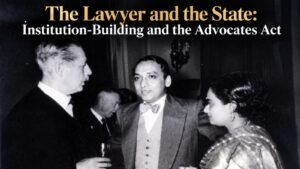
One of the more revealing episodes of Sen’s first tenure as Law Minister concerns not a single case or controversy but an act of institutional construction: the passage of the Advocates Act, 1961. The Act had its origins in the 1953 report of the All-India Bar Committee, chaired by Justice S.R. Das, which had recommended the creation of a unified national Bar, a single class of “advocates” replacing the older, fragmented categories of vakils, pleaders, and attorneys, governed by autonomous Bar Councils at the state and national level, with a common roll entitling an enrolled advocate to appear in any court in the country, including the Supreme Court. The resulting Bill was introduced in the Rajya Sabha in November 1959, referred to a Joint Select Committee whose report was placed before the House in April 1960, passed by the Lok Sabha in late April 1961, and brought before the Rajya Sabha for final consideration on 4 May 1961 by the Law Minister personally, who moved that the Bill, to amend and consolidate the law relating to legal practitioners and to provide for the constitution of Bar Councils and an All-India Bar, be taken into consideration. It received the President’s assent on 19 May 1961.
The Advocates Act is worth dwelling on because it complicates any account of the lawyer’s public role that stops at litigation or even at constitutional argument. Building the Bar Council of India, giving the profession a single title and a common roll, and vesting disciplinary and regulatory authority in bodies elected by the profession itself was not adjudication, and it was not, in the ordinary sense, politics either. It was institution-building, undertaken by a lawyer who was simultaneously the profession’s legislative architect and, for decades afterward, one of its most senior working members. The example suggests that the responsibilities of the public lawyer cannot be confined to winning cases or even to shaping doctrine; they extend to constructing the very apparatus, Bar Councils, enrolment, professional discipline, through which the profession as a whole exercises its public function. Whether Sen’s dual position as Law Minister and, later, as a leading Senior Advocate and Bar association president compromised, or, on the contrary, strengthened the independence of the institution he had helped build is a question worth holding in view rather than resolving too quickly; it recurs, in a different and more difficult form, in the constitutional and legislative episodes considered next.
VI. The Lawyer as Constitutional Actor: Two Amendments, Two Tensions
If the Advocates Act shows the lawyer as institution-builder, two constitutional amendments passed under Sen’s stewardship, one in each of his tenures, twenty years apart, show the lawyer as a direct participant in reshaping the constitutional text itself, and expose two quite different tensions in that role.
The first is the Constitution (Seventeenth Amendment) Act, 1964, enacted during Sen’s first tenure in response to judicial invalidation of certain state land-reform measures. The amendment enlarged the categories of land eligible for protection under Article 31A and added a further forty-four statutes to the Ninth Schedule, thereby placing them beyond the reach of judicial review on the ground of inconsistency with fundamental rights. The amendment, along with the First and Fourth Amendments before it, was challenged in I.C. Golaknath v. State of Punjab, where a majority of the Supreme Court in 1967, reversing its own earlier position in Sajjan Singh, held that Parliament’s amending power under Article 368 could not be used to abridge fundamental rights, applying the doctrine of prospective overruling so that the Seventeenth Amendment itself survived even as future amendments of the same kind were foreclosed. The episode illustrates a genuine strain within the idea of the lawyer as constitutional actor: the Seventeenth Amendment was defended, including by the government of which Sen was a senior legal member, as necessary to secure a substantive constitutional commitment, land redistribution, and through it the socio-economic transformation the Directive Principles gestured toward, even as it did so by insulating legislation from the ordinary discipline of judicial review that lawyers, in their professional register, exist to invoke. A Law Minister defending the propriety of shielding a class of statutes from constitutional scrutiny occupies an uncomfortable position for a professional whose ordinary work depends on that scrutiny being available.
The second episode belongs to Sen’s later tenure and involves considerably less ambiguity about his personal role. The Constitution (Fifty-second Amendment) Act, 1985, which inserted the Tenth Schedule and introduced India’s anti-defection law, was piloted in Parliament by Sen as Law Minister. Its Statement of Objects and Reasons, in a phrase that has been repeatedly recalled since, described the “evil of political defections” as a matter threatening to undermine the foundations of the country’s democracy. The Lok Sabha debated the Bill for more than seven hours on 30 January 1985 and passed it unanimously; the Rajya Sabha did so the following day, aided by a government majority so large, following the 1984 elections, that opposition cooperation was not strictly necessary to its passage. Here the lawyer’s contribution is more clearly that of a drafter of constitutional architecture: the Tenth Schedule created a wholly new category of legal event, disqualification on the ground of defection, assigned a quasi-judicial adjudicatory role to the Speaker or Chairman of the House concerned, and constrained, in the name of political stability, the individual legislator’s freedom to vote or speak against the party whip. Read together with the Seventeenth Amendment two decades earlier, the anti-defection law suggests a consistent thread in Sen’s constitutional work: an inclination to use the amending power to resolve problems, insecure land reform, unstable legislatures, that the ordinary operation of law and politics had failed to resolve, even where the solution constrained a value, judicial review in one case, individual legislative conscience in the other, that a lawyer’s professional formation might ordinarily be expected to prize. What participation in constitutional lawmaking of this kind demonstrates is not that legal training guarantees principled outcomes, but that it supplies the technical means by which political judgments, whatever their content, are given lasting constitutional form.
VII. The Ethical Problem: Shah Bano and the Limits of Legal Expertise
If the anti-defection law shows Sen executing a Cabinet decision with technical fluency and little apparent personal ambivalence, the controversy surrounding the Shah Bano case exposes, more sharply than any other episode in his career, the difficulty of being simultaneously a lawyer and a political actor. In April 1985, a five-judge Constitution Bench led by Chief Justice Y.V. Chandrachud held, in Mohd. Ahmed Khan v. Shah Bano Begum, that a divorced Muslim woman was a “wife” for the purposes of Section 125 of the Code of Criminal Procedure and could claim maintenance from her former husband where she was unable to maintain herself, and that this secular provision was not displaced by Muslim personal law. The judgment provoked sustained protest from conservative religious opinion, organised in part through the All India Muslim Personal Law Board, which characterised the Court’s reasoning, including its remarks on Quranic interpretation, as an intrusion into religious doctrine. Facing this pressure and, by most accounts, weighing the electoral cost of allowing the judgment to stand unmodified, the Rajiv Gandhi government moved to legislate the position back toward that urged by the Board. The Muslim Women (Protection of Rights on Divorce) Bill, 1986 was introduced in the Lok Sabha on 25 February 1986 by the Law Minister; it confined a husband’s maintenance obligation to the iddat period, shifting subsequent responsibility to relatives or, failing them, State Wakf Boards. Arif Mohammad Khan, then a minister in the government, resigned in protest before the Bill’s introduction, and the episode became, and largely remains, one of the most contested moments in the country’s post-Independence politics of religion, gender, and law.
What makes the episode significant for the argument of this article is not simply that Sen, as Law Minister, introduced a Bill that reversed a Supreme Court judgment; Law Ministers do that, and it is a normal exercise of the legislative response contemplated by any constitutional system in which judicial interpretation of a statute can be revisited by the legislature. What is significant is the documented movement of the Law Minister’s own position in the months preceding the Bill’s introduction. Contemporary reporting from the period recorded that Sen had, as late as June 1985, endorsed a note from the Law Secretary defending the correctness of the Shah Bano judgment and opposing its legislative reversal, and that by early February 1986, when Arif Mohammad Khan met him to restate his own opposition, the government’s, and the Law Ministry’s, position had shifted toward introducing the reversing Bill regardless. Whatever combination of considerations produced that shift, the sequence illustrates with unusual clarity the article’s central conceptual difficulty: a lawyer occupying the office of Law Minister owes, at least in principle, a professional duty to legal correctness, to the accurate assessment of what a judgment holds and requires, that is distinct from, and in this instance apparently overridden by, the political duty a Cabinet minister owes to the government of which he is a member. The Law Ministry’s own institutional advice, on the available record, favoured one course; the legislative outcome took another. A lawyer who becomes a minister does not lose the capacity for correct legal judgment; what the Shah Bano sequence suggests is that such judgment, once housed within a Cabinet, competes with, and can be overridden by, considerations that have nothing to do with the law’s correct interpretation.
The subsequent judicial history softened, without erasing, the political outcome. In Danial Latifi v. Union of India, decided in 2001, a five-judge Bench, with Danial Latifi, who had appeared for Shah Bano in 1985, now appearing to defend the 1986 Act’s constitutionality, upheld the statute but read its central phrase, “reasonable and fair provision and maintenance,” as requiring a husband to make provision adequate to sustain the divorced wife beyond the iddat period, not merely during it, substantially restoring in interpretation what the legislation had appeared to withdraw in text. The Court thereby resolved, through ordinary statutory construction rather than through invalidation, a controversy the legislature and the executive had been unable or unwilling to resolve on principled terms in 1986. That the final, durable settlement of the Shah Bano controversy came from judges applying interpretive method to a statute, rather than from ministers weighing political cost, is itself a reminder that the various institutions through which lawyers exercise public power, the Bench, the Bar, the ministry, do not always pull toward the same outcome, and that the lawyer’s move from one to another is not simply a change of address but a change in the kind of reasoning that becomes possible.
VIII. Professional Independence and the Return to the Bar
Set against the compromises visible in the Shah Bano episode, another feature of Sen’s career deserves attention: his repeated choice, across four decades, to remain identified with the Bar rather than to convert political prominence into a permanent judicial or bureaucratic career. The refusal, in his mid-forties, of an offer of elevation to the Supreme Court is the clearest instance, but the pattern is broader. He continued to practise as a Senior Advocate through the long interval between his two ministerial tenures, served as president of the Supreme Court Bar Association for nearly a decade, and was still active enough at the Bar in his eighties to appear as an arbitrator in a major commercial matter, drawing recorded admiration from sitting judges for the range of his knowledge. This sustained attachment to the Bar complicates any reading of Sen purely as a political lawyer who used legal training as a route into office. It suggests instead someone who understood ministerial office as one register among several in a longer professional life anchored at the Bar, a career structure quite different from that of a lawyer who enters politics and leaves the profession behind.
Whether this pattern strengthens the case that professional independence and public service are compatible, or whether it merely shows that a sufficiently eminent lawyer can absorb the compromises of ministerial office and still be welcomed back to a profession that judges its own by different standards than it judges politicians, is not a question the historical record by itself settles. What can be said is that the Bar to which Sen returned, and over which he presided, was not a private guild indifferent to public life; it was itself, through the Bar Councils the Advocates Act had created, through its role in constitutional litigation, and through the discipline and standards it enforced upon its own members, a public institution, arguably a constitutional one, in the sense that its independence from both government and client pressure is a condition of the courts’ own capacity to function. On this view, public life for a lawyer does not begin with the assumption of legislative or ministerial office; the Bar is already a form of public life, and Sen’s decision to remain rooted in it, even while moving repeatedly into and out of government, can be read as an assertion, however imperfectly realised in episodes like Shah Bano, that the two are not, and should not be, entirely severable.
IX. A Distinctive Indian Pattern?
Broadening beyond Sen, the question worth asking is whether the Indian experience has produced a genuinely distinctive model of the lawyer in public life, or whether Sen’s career is simply an unusually long-running instance of a pattern common to many common-law jurisdictions. Two features seem, on the evidence surveyed here, particular to the Indian trajectory. The first is continuity across the independence divide: unlike jurisdictions where the professional class that led an anti-colonial movement was largely displaced by a new political class after independence, the Indian pattern shows lawyers moving smoothly from the register of resistance, arguing against colonial power, to the register of construction, drafting the Constitution, then the ordinary statutes that gave it institutional form, then successive amendments to it, without any generational rupture. Sen’s own recruitment by a figure of the freedom-movement generation is itself evidence of this continuity. The second is the sheer durability of the dual identity: it is difficult to find, in comparable democracies, a legal figure who combined a cumulative decade-plus tenure as the minister responsible for the administration of justice with a simultaneous multi-decade standing at the Bar and the presidency of the Bar’s own apex professional body, offices that, in other systems, are more often treated as incompatible or are separated by a clean retirement from practice.
What has changed, in the decades since Sen’s second tenure ended, is the balance of these registers within the profession as a whole. The post-Constitution growth of public-interest litigation, judicial activism from the 1980s onward, and the development of a specialised constitutional Bar have created a class of lawyers whose public significance runs almost entirely through courtroom argument and rarely through ministerial office, a shift from the lawyer-legislator-minister model Sen exemplified toward a lawyer-litigator-policy-advocate model in which public influence is exercised by shaping doctrine rather than by holding a portfolio. What has not changed is the underlying premise that legal argument in India is never merely private: whether exercised from the Bar or from the Treasury Bench, it is understood, by lawyers and by the wider public, to carry consequences for how the Republic itself is governed.
X. Conclusion: The Lawyer Between Citizen and State
Five propositions emerge from this reading of Sen’s career, offered not as settled conclusions but as the strongest account the evidence here supports. First, the Indian lawyer has never been confined to the courtroom; the profession’s involvement in the freedom movement and in constitution-making made public engagement a professional inheritance rather than an individual choice. Second, legal expertise, once placed in ministerial hands, becomes a form of public power in the fullest sense, capable of building institutions such as the unified Bar, and of reshaping the constitutional text itself, as the Seventeenth and Fifty-second Amendments show. Third, the Bar itself, not only Parliament or the ministry, is a site of public life, and a lawyer’s return to it after political office is not a retreat from public responsibility but a continuation of it in a different register. Fourth, the movement of a lawyer into politics generates tensions that legal training does not resolve and may not even soften; the Shah Bano sequence shows a Law Minister’s own legal judgment being set aside by the political calculations of the government he served, a fact that ordinary professional ethics, framed around the duties owed to a client or a court, has little vocabulary to address. Fifth, and consequently, the measure of a lawyer’s public service cannot be the number of offices held; it must be sought in the relationship, case by case, between the legal expertise exercised and the institutional integrity, of the Bar, of Parliament, of the Constitution, that expertise either strengthened or was made to serve.
The Indian lawyer in public life, on the evidence of Sen’s career, occupies a position that has no single, stable name: not quite citizen and not quite State, not quite counsel and not quite legislator, moving between the vocabulary of rights, which the advocate is trained to assert against government, and the vocabulary of governance, which the minister is required to exercise through government. What Sen’s life ultimately suggests is that this position is sustainable, in the sense that a career can be built and a republic can be served from within it, but that it is not innocent: the same fluency that allows a lawyer to move between Bar and Cabinet without evident strain is also what allows political compromise to be absorbed into legal form, so that a defeat for legal principle, as in the legislative reversal of Shah Bano, can be transacted through exactly the same drafting competence that, in the Advocates Act, had built an instrument of professional independence. The Indian lawyer in public life is, in the end, neither simply the guardian of the Constitution nor simply its instrument, but the figure through whom the distinction between guarding and instrumentalising the Constitution is continually, and never finally, negotiated.
Sources and Further Reading
- The Advocates Act, 1961 (Act No. 25 of 1961), India Code, Ministry of Law and Justice — https://www.indiacode.nic.in/handle/123456789/1631
- Rajya Sabha Debates, 4 May 1961, The Advocates Bill, 1961 (motion for consideration moved by the Minister of Law, Shri A.K. Sen) — https://rsdebate.nic.in/bitstream/123456789/555765/1/PD_34_04051961_12_p2083_p2144_15.pdf
- The Constitution (Seventeenth Amendment) Act, 1964
- I.C. Golak Nath and Ors. v. State of Punjab and Ors., AIR 1967 SC 1643
- The Constitution (Fifty-second Amendment) Act, 1985 (Tenth Schedule; anti-defection law)
- Mohd. Ahmed Khan v. Shah Bano Begum, 1985 SCC (2) 556
- The Muslim Women (Protection of Rights on Divorce) Act, 1986 (Act No. 25 of 1986)
- Danial Latifi & Anr. v. Union of India, (2001) 7 SCC 740 — https://indiankanoon.org/doc/410660/
- Lok Sabha, Obituary References on the passing of Shri Ashoke Kumar Sen, 2 September 1996, eParlib, Sansad — https://eparlib.sansad.in/bitstream/123456789/5816/1/11_II_02081996_p3_p5_t1.pdf and https://eparlib.nic.in/bitstream/123456789/809320/1/pms_11_02_02_09_1996.pdf
Secondary Sources
- “Calcutta High Court Bar Library unveils portrait of former Law Minister Ashoke Kumar Sen,” Bar and Bench, September 2026 — https://www.barandbench.com/news/calcutta-high-court-bar-library-unveils-portrait-of-former-law-minister-ashoke-kumar-sen
- “Calcutta High Court Chief Justice Unveils Portrait Of Late AK Sen At High Court Bar Library Club,” LiveLaw, 12 September 2026 — https://www.livelaw.in/news-updates/calcutta-high-court-chief-justice-unveils-potrait-of-late-ak-sen-at-high-court-bar-library-club-549806
- “Calcutta Bar Library Club unveils portrait of late Senior Advocate Ashoke Kumar Sen on its 200th Anniversary,” SCC Online Blog, September 2026 — https://www.scconline.com/blog/post/2026/09/14/calcutta-bar-library-club-ashoke-kumar-sen-portrait-unveiling/
- “Ashoke Kumar Sen – India’s inevitable law minister for decades,” ThePrint, 12 March 2019 — https://theprint.in/india/governance/ashoke-kumar-sen-indias-inevitable-law-minister-for-decades/132222/
- Kapil Sibal, “Each Reform Raised The Threshold, Each Threshold Became A Target: Six Decades Of Anti-Defection Law,” LawChakra — https://lawchakra.in/legal-updates/aaya-ram-gaya-ram-tenth-schedule-history-deemed-merger/
- “The Indian Supreme Court and constitutional amendments: insights for the debate on the comparative political process theory and the comparative representative reinforcement theory,” Global Constitutionalism, Cambridge University Press, 2025 — https://www.cambridge.org/core/journals/global-constitutionalism/article/indian-supreme-court-and-constitutional-amendments
- Girilal Jain, “Unanswered Questions,” Editorial, Girilal Jain Archive (on Law Minister Ashoke Sen’s position on the Muslim Women Bill, 1986) — https://www.girilaljainarchive.net/?p=713
- “Republic Day: The Lawyers who helped draft the Constitution of India,” Bar and Bench, 26 January 2023 — https://www.barandbench.com/columns/republic-day-lawyers-constitution-india