
Abstract:
Two most impressive theories have been proposed to understand from a global perspective the ongoing debates on globalisation and its implication.The first proposal came from Emeritus Professor William Twining of UCL (2017). The second proposal came from the School of Oriental & African Studies (SOAS) andEmeritus Professor Werner Menski (2006). Within the context of their respective theoretical efforts, this article examines the ongoing struggle of post-colonial nation-states to manage legal pluralism in terms of cultural-religious personal laws. I argue that asking for ‘one nation’, ‘one law’ and ‘one legal theory’ on the basis of legal positivist theory seems not only boring and too simplistic and idealistic. Its old idealistic and almost child-like desire of asking for the moon risks ignoring the limits of law (Allott, 1980) as well as the deeply anchored plurality of all law-related phenomena to contextualising the development in legal theories. A realistic vision of the world, and the world of law, seems to have to respect the diversity of the world and diversity in-laws. It is actually part of the DNA of the ongoing globalisation processes.
1. Introduction
The process of ‘globalisation’ is backbreaking some of the nostalgic-settled assumptions of the various fields (Robertson, 1990: 15-30). The world is ‘sensing’ a different kind of sense – a common sense (Santosh, 1995) which is not completely a new sense or new world (Twining, 2000: 4) but the sense of ‘feelings’ has become ‘the cliché of our times’ (Held et al., 1999: 1 & Menski, 2006: 3). In this puzzled transitional situation, the academia and nation-state have been revisiting their theory and position in ongoing debates on globalisation and its implications (Menski, 2006: 3-17; Twining, 2000: 1-4). The settled legal positivistic assumptions of Western traditions of academic law are also facing traumatic challenges (Twining, 2000) to maintain emerged cosmopolitan global society. Before the process of global theory was widely misunderstood, as scholars widely argued (Featherstone, 1900; Robertson, 1990; Santosh, 1995) that genuine meaning of globalisation was ‘(1) genuinely worldwide, (2) widespread geographically, (3) anything transnational (4) anything related to increased interdependence’ (Twining, 2017: 123), while some others promoted plurality-consciousness rather than following uniform moral standard or asking for integration of all kind of laws. Legal scholars responded (Menski, 2006; Twining, 2000), asserted and argued that the real purpose of the globalisation should be to promote the local knowledge, local laws and that unthinking unifying globalisation marginalised culture, and specifically Asian and African legal postulates (Menski, 2006).
The article first examines in outline, two theories that have been proposed to understand from a global perspective the ongoing debates on globalisation and its implication. The first proposal came from Emeritus Professor William Twining of UCL. The second proposal came from the School of Oriental & African Studies (SOAS). The proposed theories on global perspectives of law yield ultimately a more learnable, hybrid, equitable, cosmopolitan and healthy understanding of theories of law and justice. To side-line the news of contemporary needs and expectations of Asian and African to manage their family affairs according to their culture-specific principles overlooks that people want to manage their own laws and law-related affairs and cannot necessarily count on state-centric legal structures to ensure dignified survival.The bigger issue here seems to be the role of the state in Asia and Africa, which is seriously undertheorized.
Therefore, the somewhat Eurocentric escapism when it comes to managing legal plurality is not going to work in the context of globalisation. In reverse, global Southern complexities of living while facing postcolonial trauma and feeling an inferiority complex that they have ‘not one law’ needs to be addressed. The proposed theory, despite having its own limitations, gives scope to celebrate global southern legal plurality, diversity in laws and learning ‘navigating skill’ to manage the complex culture-specific situations that arise.The global south, instead of asking for the moon of uniform law as a presumed guarantor of justice, should instead focus on managing socio-cultural-legal diversity.
The research then specifically turns to India to trace a brief history of India’s personal law system and to shows that India somehow managed the inherent contradictions between claims of legal uniformity and the reality of diverse communities, based on personal law practices. Giving the example of India’s experience of managing legal pluralism, this study wants to shows that despite loud criticism, India has been quite successful in a diversity with a harmonised personal law system that is a kind of compromise between a completely Uniform Civil Code (UCC) and traditional personal law structures for the many different kinds of Indian people. India’s way of handling this problem may enlighten the world, but it is also a fact that India is not unique in having a personal lawsystem, which seems part of the DNA of the Global South, while the Global North claims to have overcome such challenges.
Legal positivists argues that there is principally a contradiction between legal pluralism and legal universalism; and legal pluralism theories and practices are insufficient to manage gender-conscious rights protection, national integrity and secularism. Finding an appropriate balance between rights of different identities exemplifies how the post-colonial Indian parliament and courts have managed to develop solutions that involve above all a contested process of harmonisation between legal pluralism and legal universalism.
In conclusion, returning to the current challenges of the globalised context and theory I would emphasise that India and many Asian and African countries may be asking for a positivistic UCC, but thiswould bedivorcing socio-cultural-legal personal laws from the lived realities of huge populations, raising its own human rights concerns.The simplistic demand for uniform laws seems a childish stubborneffort in the global context of law. The article thus interrogates to what extent different laws can be managed through harmonising the various existing laws and urges that positivist theorising should moveon from the fantasy of nostalgic legal positivism.
2. Globalisation of Legal Theory: Legal Pluralisation of Legal Positivism
The process of ‘globalisation’ is taking place also at a sub-global level and moving towards a global neighbourhood, which is not yet a ‘global village’ (Twining, 2000: 160). The term ‘globalisation’ usually refers to creating and consolidating a unified world economy and a single ecological system, but also indicates a complex network of interconnectedness. It also risks a (mis)understood integration of all kinds of rules, ‘uniformisation’ of legal systems and a movement towards uniform universal moral standards, when in fact mind-boggling diversities remain visible almost everywhere, encapsulated in the neologism of ‘glocalisation’.
Various scholars have pointed out that globalisation is more than McDonaldisation, Westernisation and ‘uniformisation’ of the world (Robertson, 1990). Menski (2006: 25) has warned that ‘[i]f globalisation means increasing hybridisation in locality-coloured and culture-specific forms worldwide, rather than uniformising homogenisation, lawyers need to be better equipped’ to handle such challenges in theory as well as in practice.
Defining the character of globalisation as a new common sense, Boaventura de Sousa Santos (1995: 263) has asserted that globalisation is not single-handedly moving in the direction of centralisation. At the same time, the ongoing process of ‘globalisation’ is still stigmatised as the domination of western-cultural-market hegemony (Doshi, 2003), while Glenn (2004: 51) observed that ‘there are a number of globalizations going on’.
Faced with such fundamental predicaments, the globalisation of legal theory cannot simply proceed along lines of argument that privilege uniformity and seek to abolish or ban various forms of diversity. The entire article, starting from the global context, extending to the challenges to nation states and communities and/or societies, ultimately cannot ignore the law-related impacts of individuals’ assertions of their own sets of values and preferences, and this goes not only for powerful ruler figures and high-ranking politicians and lawmakers, but also for common people around the world, whose voices cannot be completely ignored in globalising theorisations of the vast field of law.
2.1 Globalisation and Understandings of Law
Numerous scholars have reacted to this predicament and produced writings in various academic fields to understand the scope, characters and nature of globalisation (Held et al, 1999 & Santos, 1995). The discipline of law also widely reacted in response to the challenges of globalisation and it has given rise to a large body of writing (Baxi, 2008; Christodolidis, 2021; Edge, 2000; Menski, 2006, 2010, 2014; Twining, 2000, 2002, 2009, 2009a, 2011, 2021), to name but a few. The main proposer, and dominant believer of positivist law, sharply identified and critiqued by Chiba (1986: 1-2) as ‘Western model jurisprudence’, is nervously debating and resisting the management of plural forms of citizenship and law in existing and newly developing multicultural societies, especially after ongoing huge waves of migration across the globe (Menski, 2014:190-196). The global north is legally reluctant to accept the laws and values of migrants from Asian and African countries (Aixelà-Cabré, 2021), who made their new homes in the erstwhile colonial centres (Ballard, 1994). The presumed ‘exceptionalism’ of personal laws of the global south has become a general trend and a form of dramatic performance (tamasha) in the global North (Menski, 2012: 187; Twining, 2000: 225).
Post-colonial African and Asian countries thus find themselves in a transitional period between maintaining their different personal laws and trends towards unification of law on the basis of positivist theory. The extended debates about the abolition of personal laws have continued to put pressure on those Asian and African nations whose strategy is to maintain a personal law system (Amien & Farlam, 1998; P Ghosh, 2007; Verma, 2006). Such pressure has been justified by recognising international human rights principles of gender equality as well as the positivist theorising of the law of the twenty-first century (Anderson, 2011; Baxi, 2008; Twining, 2002 & 2011). In a globalising world, all of this shows that a new vision of understanding the role of law is required in line with global theoretical understandings of tolerable legal developments that manage to avoid human rights violations by giving in to too much diversity, which might become intolerable (Twining, 2009).
Two most impressive theories have been proposed to understand from a global perspective the ongoing debates on globalisation and its implication.
A leading explorer of the implications of globalisation on contemporary legal theory, Twining (2009) presents a revised version of general jurisprudence. The notable point is that Twining (2009: 21) claims that he has no intention to propose any new theory. Reiterating that point also later (Twining, 2017) writes that he is merely revising general jurisprudence. But Ralf Michaels (2013: 287-304) understands this proposal as a theory of legal globalisation. I also see that such revisions are part of a revised model of general law that seeks to move towards uniformity.
The second proposal came from the School of Oriental & African Studies (SOAS), where Emeritus Professor Werner Menski (2006) examined the implications of globalisation on state laws, socio-legal norms, and different kinds of related values, including religion. Later, Menski advocated an approach to legal theory in the form of flying kites in a global sky (Menski, 2009), proposing a new model of jurisprudence that acknowledged the inherent conflicts and tensions between traditional and modern forms of values. This model, applied in analysing the historical and conceptual development of Hindu law, Muslim law, African laws and Chinese law allows much room for critical debate of the manifestations of legal pluralism, which often, as many critics have noted, risk infringements of basic human rights as understood in globalised international law contexts. In turn, Menski and others would argue that such approaches risk infringing local people’s ways of life and long-established normative patterns. Evidently, there is much room for disagreement between these kinds of approaches. Both proposals also discuss the impacts of globalisation on Asian and African countries and jurisdictions in the context of the debates about abolishing different personal laws. The proposals of both scholars assess relevant jurisprudential theories and contextualise them in interactions with other legal theoretical debates.
2.2 Twining’s Revision of General Jurisprudence
Both scholars (Menski, 2006: 3-24; Twining, 2006: 5-14) seem to agree that in the context of globalisation sovereign states are in a stage of transformation. In this regard, Held et al. (1999) had broadly categorised nation-states at three levels: (a) Hyperglobalists, which would be the end of national sovereignty), (b) Sceptics (strengthening nation power) and (c) Transformationalist (observing an uncertain relationship, but a continued role of sovereignty, in efforts to make law ‘work’ for achieving better justice). While globalisation and sovereignty seem inherently paradoxical, the co-existence of both characterises the contemporary world order (Tierney, 2015: 1-13).
Twining (2009: 21) proposes a reviving and alternative model of general jurisprudence. It is first important to know what general jurisprudence is and where Twining disagrees with it. In short, general jurisprudence is a product of the mind of Jeremy Bentham, who constructed the idea of ‘universal jurisprudence’ applied around the world (Tamanaha, 2011: 1). Bentham’s vision of universal jurisprudence converted into general jurisprudence by his disciple Austin (Twining: 2000: ch.1). This has been a part of the legal positivist tradition as legal science ever since.
The basic character of the general jurisprudence of law is also known as the ‘separation thesis’, which defines that there is no connection between ‘law as it is’ and as it ‘ought to be.’ Earlier jurists like Austin (1863), Pollock (1882), Gray (1909) and Buckland (1945) explicitly emphasised the ‘particularity’ of law in their study. Twining (2000: 9) argues from here that in the general jurisprudence and particular jurisprudence perspective, law is exclusive and does not include non-state laws, but acknowledges (Twining, 2000: 24) that ‘an old favourite in Austenian analytical jurisprudence may be ripe for a revival in a global context.’
Hart (1961) more explicitly distinguished general jurisprudence and particularity as a system covering primary and secondary law deriving their validity from the ‘rule of regulation.’ This is useful in terms of many aspects of the global concept of the nation-state. But, differentiating himself from Hart, Twining (2009; 12) says that despite 40 years of dominance of Hart’s views of law, this ‘sits uneasily with various forms of legal orders, with various forms of regional law or normative orderings emerging from-self-regulating or commercial practices.’
Thus, looking at the intellectual inadequacies of western and especially Anglo-American jurists, Twining presents his thoughts that although Western traditions of academic law have a rich heritage, general jurisprudence needs to be revised in the new global context. Proposing his revised version of general jurisprudence, Twining (2009: xi) argues that general jurisprudence is generally parochial, narrowly focused, unempirical, and tending towards ethnocentrism. Western general law is state-oriented, so-called secular, positivist, ‘top-down’ law. Furthermore, Twining (2009: xi) contextualises these debates in a global perspective by proposing that:
[a] healthy cosmopolitan discipline of law should encompass all levels of social relations and normative and legal ordering of these relations and normative and legal ordering of these relations. This mainstream Western canon of jurisprudence needs to be critically reviewed and extended to take more account of other legal traditions and cultures, and of problems of conceptualisations, compression, generalisation and critique about legal phenomena in the world as a whole.
Pointing out some crucial elements, Twining (2000: 245-256, 2009: 1-31) furthermore highlights that a reasonably inclusive map of law in the world encompasses various forms of non-state law and religious and customary laws, including non-Western religious law. In effect, like Glenn (2004) he argues that other legal traditions and juristic canons need to be included, as well as ‘southern jurists’, thus embracing what Menski would call legal pluralism.
Twining (2000 & 2009) suggests that classical western jurisprudence of natural law and legal positivism need to be appraised, revised and reinterpreted in the context and peripheral relation between sovereignty, colonialism, post-colonialism, feminism and globalisation. Moreover, Twining (2000) contends that jurisprudence can be understood as an ideology, activities and heritage, based on notions of ‘archive’, an important concept that is further discussed later in this paper.
2.3 Twining’s Positivist Heritage and Menski’s Cultural Heritage
Despite some critical reactions from academia to Twining’s revised version of general jurisprudence in a global context (Tamanaha, 2011; Michaels, 2013; Priel, 2013), it is welcome as a very important intervention. Menski (2000: 245-256, 2009: 1-31) also gives much credit to Twining for suggesting globality-conscious legal plurality. Sharing Twining’s optimism, Menski (2006: 129) intervenes in this debate by claiming that legal theory and jurisprudence, especially for studying Asian and African laws, are still too parochial and Eurocentric to meet the global challenges.
The comparative study of legal theory and jurisprudence by Menski (2006), especially as it is developed in regard to Asia and Africa, goes well beyond the comfort zone of those who cherish positivist notions of law and understands the entity of law through cultural-sociological perspectives. Menski (2006: 25-81) argues that laws are everywhere cultural-specific and Asian and African legal systems thus cannot be looked at merely through positivists’ eyes and from a top-down perspective. Menski seeks to understand the law from the bottom-up perspective, which is also a characteristic of a revised version of the general jurisprudence approach, where the flexible common sense of Asian and African people is inherently observed, somewhat respected, and certainly analysed by experts on non-Western laws.
Menski thus differentiates his work from that of Twining by arguing that law can be better mapped from a cultural perspective, while Twining has remained reluctant to accept this. Menski goes beyond legal positivism and general jurisprudence as cultural relativism, whereas Twining remains notably attached to the prominence or primacy of legal positivism. Twining (2009: 27 note) says that he is a ‘weak positivist’ and H.L.A Hart was a strong positivist. This rigid attachment of Twining with Western concepts of general jurisprudence stopped him from studying jurisprudence by taking account of the details of its actual manifestation. Tamanaha (2001, 2017) in his Realistic Theory of Law also confirms that general jurisprudence is limited when it comes to understanding the actual manifestation of law.
Menski would agree that Twining is not a reluctant legal pluralist like H.L.A Hart, he whole-heartedly embraces legal pluralism. But Twining is reluctant to account fully for the law’s polyphonic cultural perspectives that introduce what Menski seems to acknowledge as irritating evidence of messy diversities. Law is supposed to be, ideally, clear-cut and certain. In this context, though, Twining’s idea of looking at jurisprudence as Heritage is quite valuable, artistic and useful to understanding the intellectual history of legal jurists. He emphasises a revision of contemporary juristic Heritage and gives an account of jurists. But this is still limited, which Twining admits and defines as an inherent problem of general jurisprudence. He still looks at the law through a (weak) positivist lens, where the possibilities of including global southern jurists’ accounts automatically decrease. The simple intervention of Menski (2006) is that he looks at laws as culture-specific, relying in this regard on Allott’s (1980) writing on the limits of law. This gives hope to thousands of presently side-lined jurists from Africa and Asia. Twining’s important book on Human Rights and Southern Voices (Twining, 2009a) only discusses alternative positivist supporters such as Francis Deng (Sudan), Upendra Baxi (India), Abdullahi An-Na’im, (Sudan) and Yash Ghai (Kenya). The list of the intellectual historical heritage of jurists would be surprisingly increased if the law were to be mapped in accordance with Menski’s perspective. Here, Khalil Gibran’s poetic[1] lines are relevant to understand the difference between the methodologies of Twining and Menski. Khalil Gibran (1833) writes: –
‘The river needs to take the risk
of entering the ocean
because only then will fear disappear,
because that’s where the river will know
it’s not about disappearing into the ocean,
but of becoming the ocean.’
Twining sits on the bank of the ocean of cultural laws and looks at the ocean without entering it, because he fears that he will disappear (or rather, legal positivism will disappear in the depth of legal pluralism), whereas Menski enters the ocean of cultural-specific plurality of laws to become part of the ocean. This more inclusive approach of course risks ruining the presumed ‘special nature’ of law, but it illustrates its inevitable connectedness with all law-related manifestations.
2.4 Human Rights and Global Voices of Africa and Asia
While Menski’s understanding of law is culture-specific and thus diversity-conscious, this socio-cultural-religious specific law is critiqued as ‘righticidal’, as Baxi (2008) has called this, by those who base their legal analysis purely on human rights perspectives (Gräb & Charbonnier, 2015). The area of Asia and Africa personal laws, in particular, is thus under attack by human rights lawyers, activists, western people, general jurisprudence jurists; and also globalisation and transnational networks of social movements such as the United Nations, the United Nation Human Rights Commission, many NGOs, and others for not respecting the minimum human dignity/rights of its own people, religious prosecution and state arbitrations. The southern people are referred to as fundamentalists, risking adherence to intolerable practices, and particularly gender inequality. This blame is somehow true, and somehow sometimes exaggerated. Some good literature has been produced against the western notion of human rights. Examples of exaggeration can be found in Mohsin Hamid’s Novel, The Reluctant Fundamentalist (2007) and Ahdaf’s Novel, The Map of Love (1999).
Menski (2014) replies to these questions in his extensive research that ‘these attitudes of ‘truth’ and ‘exaggeration’ must be rigorously examined. Menski (2014: 96) cautioned against so-called profit-driven activists, lawyers, intellectuals and judges who sometimes intentionally work on western-driven agendas against the various sociocultural, personal and indigenous laws. He argues that no rights and law can succeed without wide civic participation. Neglecting socio-cultural-religious diversity, and the participation of local people, no top-down human rights approach is going to succeed.
Judging the ‘future of human rights,’ Baxi (2008) also endorsed this view that global southern people have a long cultural history of human rights, and gave examples of Ambedkar, Gandhi and Nelson Mandela. He emphasises that ‘culturalisation’ of human rights is one of the demands of postcolonial society. The extensive research of Amartya Sen (2005) goes far beyond the modern period, tracing India’s argumentative tradition. He finds that thesis and antithesis of human rights are an inbuilt character of Indian society. Sen’s pieces of advice advocate the ‘rational’ characteristics of global south characters.
The edited volume of Twining (2009a) discusses four legal scholars’ stand points, interests, concerns and beliefs of non-western people, involving Francis, Baxi, An-Na’im and Ghai.Twining (2009a: 2) characterises that ‘these thinkers are both significantly similar and strikingly different.’ The similarities are that all believe in the cultural dimension of human rights.
Menski (2012: 187-210) seems to treat the right to culture as a prominent part of human rights now, certainly not without limits, but on an equal footing with Western presumptions about human rights. But western countries and many scholars are still reluctant to accept the cultural-religious and personal laws of the global South. The excuses of Western scholars for the ‘exceptionalism’ of Islamic laws, Hindu Laws, Chinese laws and African laws are not excusable (Yilmaz, 1999) in this new dimension of legal analysis. Further excuses are given by some scholars that Western countries are secular and including religious and cultural conceptions of law would create a messed-up situation (Priel, 2013). This seems to reflect a kind of superiority complex. Tamanaha (2021: 97-127) finds and exposes large cracks in this idealized projection of the monistic law state. Romani (Gypsy) communities across Europe have lived by their laws for a thousand years. Indigenous law and tribunals exist in New Zealand, Canada, Australia, and the United States, in various relationships with state law. Twining (2000: 225) more precisely summarises that now Western jurists have become more conscious of ‘multi-culturalism’. As societies have become more plural, today state legal pluralism is an increasingly recognised fact in nearly all countries, hidden behind terms like ‘asymmetric’ and of course all kinds of ‘affirmative actions’ for specific groups (See also, Yilmaz, 1999). The increasing presence of multinational corporations and the transformation of Islamic law in global financial markets is an evident example of the religious-economic presence in the global north (Ercanbrack, 2015).
There is also the knotty question of the subject of the universality of human rights. There are dominant views that only have universal international thoughts of legislation, human rights and state-sanctioned law as a role model of human rights. Menski (2014: 96) rejects this approach and asserts that ‘[I]f constitutions and international legal conventions are promising the moon and all that most people get is a distorted mirror image, something must be seriously wrong.’ Denying the ethical approach of the governance model, ignoring the indigenous peoples’ rights, non-western countries’ sociocultural perspectives, newly developed self-regulatory governance model, and not accepting multiple maps of laws in human rights law, human rights itself will be violating humanitarian principles. Therefore, the character of human rights is itself plural, and in the context of globalisation, it becomes more plural.
Baxi (2016: 40) succinctly appreciates the plural nature of humans in his recent writings when he observes: ‘[T]he problem with human rights is not their interpretive plurality. They mean different things to different peoples: ‘right to interpretive plurality is a human right.’ To solve this, both the north and south tussle, Anderson (2011: 364) gives a very important harnessing approach. He explains that Santos and Rodríguez-Garabito’s views on the global south are relevant for ‘the alternative knowledge of human rights outlined above and are of relevance to struggles both within and outside the South.’ Baxi (2016: 39) further argues with an updated version of the Kantian justice model in the form of the ‘deontological positions’ of John Rawls. Baxi (2016: 38) argues that the best future of human rights is that: ‘social movements for justice for the violated should be welcome in principle.’
Overall, above mention, all are homing in on the same point, namely that the alternative knowledge of human rights from the global south, Human rights views of southern voices, and cultural characters of human rights from Africa and Asia need to be carefully included in revised models of general jurisprudence.
2.5 Law in the Global Sky: A New Useful Model of Jurisprudence
The globalisation scenarios give valuable understanding that basically four competing elements of the law as a globally present phenomenon with many manifestations are found everywhere: (1) natural laws; (2) socio-cultural approaches (3) positive laws; and (4) international laws and human rights. Although no globally agreed definition of “law” has been accepted until now (Menski, 2006: 34), the pluralistic characteristic of law is convincingly established and ‘law’ as a lived experience is never just any one of those identified four elements, but always a specific mixity. It seems that, as a result, the definition of law became an ‘honorific ring’ (Harris, 1980:128) and the ‘concept of law’ remains disputed (Donlan, 2014). Thus, global society is everywhere struggling to find the ‘right law’ (Menski, 2006: 595).
In this situation, combining elements of natural law, positive law, socio-legal components and human rights, Menski (2006, 2007, 2011, 2014) suggests that these all laws always need to be harmonised through responsible decision-making in scenarios of conflict (Menski, 2018), which is the introduction to Topidi (2018). He presents the kite concept of legal pluralism and advocates this as the fourth major approach of legal theory. Tied together in that overcrowded space, they are irrevocably connected, like the corners of a kite (see the below graph). This kite model is an elaboration of the earlier triangular model of law (Menski, 2006: 612), based on the theorising of Chiba (1986).
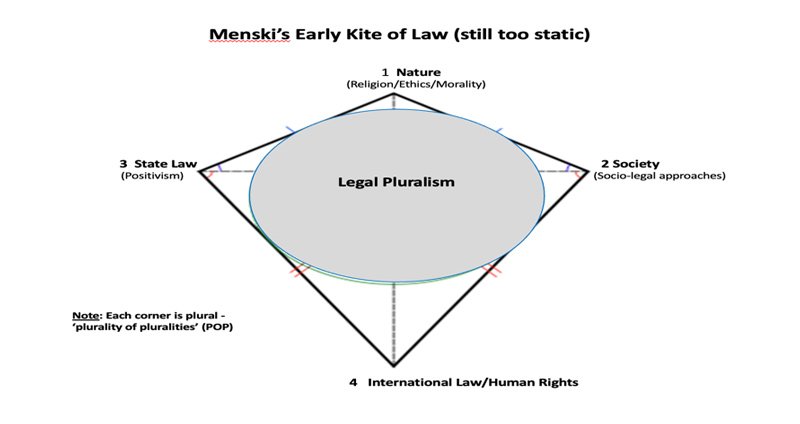
Graph-1
In sum, the kite mode of any specific legal actor gives anyone the opportunity to make the right decision, but this is of course also a terribly difficult predicament, as there are so many competing normativities (Topidi, 2018). In essence, those who can balance the kite to harmonise all the laws through their skilled cultural/legal navigation will find tolerable outcomes that work not only in terms of theory, but also apply to practice.
2.6 Law, Justice and Globalisation
The concept of the kite model of jurisprudence is of course very tricky and needs more explanation. It is linked with the idea of justice, law and global context. Amartya Sen (2008: 141) argues that the key idea is that global justice does not need the creation of a global state and in the modern world there are simply no self-contained national societies or legal orders. Evaluating Johns Rawls’s book, Theory of Justice (1971), Sen’s Idea of Justice (2009) focuses more on justice rather than law. Twining (2000: 69-74) also doubts Rawls’s law-focused theory and suggests that serious questions arise whether Rawls’s theory of justice would be applicable in practice or not. Sen (2008) explains law and justice as an old Indian philosophical concept. He discusses ‘Niti’ (law) and ‘Nyaya’ (the process of securing justice). Sen gives more preference to justice (Nyaya) rather than law (Niti). His idea of justice is that the concept of ‘Nyaya’ means that ‘Niti’ is nothing without ‘Nyaya’. ‘Niti’ is just an exercise of the power to lead, it is governance, but not necessarily good governance. ‘Nyaya’ is an ethical postulate. A challenge to find ‘the right law’, Menski’s idea of the fourth legal theory also gives more emphasis to values and postulates the centrality of Justice. The law is nothing without justice, justice can survive without law, but the law cannot survive without justice. Overall, the global context demands the harmonisation of law for securing complete justice, and the kite model of jurisprudence opens new windows. In other words, this approach to kite flying opens the sky to possibilities of flying still higher in comparative law analysis. Many judgements of the Indian Supreme Court can, by applying this particular analytical lens, be read as efforts to achieve the harmonisation of law and justice. For example, there was no provision for tolerating homosexuality in Indian law, but the court decriminalised homosexuality (Navtej Johar v Union of India (2018) 10 SCC 1) on the basis of this strategy or method of harmonising law and justice. Niti and Nyaya and Justice Chandrachud’s interpretations of 2022 are also useful to understand this concept. He emphasises ‘Niti’ does not always result in ‘Nyaya’. The finding gap between ‘Niti’ and ‘Nyaya’ calls for harmonisation of law as ‘adjudicating Rights’.
2.7 Conclusion
Twining’s global perspective of general jurisprudence is very important and undoubtedly opens a new dimension of law through legal positivist perspectives embracing legal pluralism. Menski’s cultural perspective of law, in addition, is particularly pertinent and timely in African and Asian comparative law contexts to understand the law from a cultural perspective that aims for better justice. Overall, the global perspective of relativizing the traditional role and supremacy of positivist law gives a vibrant intellectual heritage of legal jurists. It yields a more learnable, hybrid, equitable, cosmopolitan and healthy understanding of theories of law and justice. Therefore, in the global context, asking for ‘one nation’, ‘one law’ and ‘one legal theory’ on the basis of legal positivist theory seems not only boring and too simplistic and idealistic. It emphasises that realistic visions of the world, and the world of law, seem to have to respect the diversity of the world and diversity in-laws. The flux of globalisation demands, as Mao Zedong put it in 1957, that ‘[l]etting a hundred flowers blossom and a hundred schools of thought contend is the policy for promoting progress in the arts and the sciences.’ It is no coincidence that George Orwell’s anti-totalitarian writings like Animal Farm (1945) and ‘1984’ become more relevant in this context, issuing warnings about dreams or ambitions of making one law for all.
3. Revisiting Indian Jurisprudence: An Example of Managing Legal Pluralism
The previous chapter discussed the dynamic and intersectional nature of law as a global, internally diverse phenomenon. For post-colonial African and Asian countries this poses a dilemma and a challenge for retaining the right balance between maintaining their different personal laws, religious laws and natural laws, or increasing the unification of law. Harmonising the different conceptions of laws and addressing the risks of creating gaps between law and justice are major concerns.
Post-apartheid South Africa (Amien, 2021; Mofokeng, 2009) and post-colonial India have largely succeeded to maintain legal plurality and diversity (Larsen, 2001; Rudolph and Rudolph, 2001), but especially India faces calls for a UCC, as that is also explicitly mentioned in Article 44 of the Constitution. This chapter specifically turns to India to provide a brief legal history, including the history of the personal law system, and problematizes the inherent contradictions between claims of legal uniformity and the reality of diverse personal law practices.
It might be India’s way of looking at this problem that may enlighten the world (Larsen, 2001; Rudolph and Rudolph, 2001: 36-65). This may be a global contribution that western countries are usually reluctant to accept.
Overall, revisiting briefly the legal history of India this chapter argues that India from ancient, medieval and pre-colonial eras followed legal pluralism despite immense pressures to uniformise its laws. It argues that the encounter between legal pluralism and legal positivism have always been part of the legal culture of India and ultimately legal pluralism has dominated. The Constituent Assembly of India (CAI) after intense arguments managed to find an appropriate balance between expectations of legal uniformity and the needs of the many different communities of India.
3.1 Dharmaśāstra and God’s law
India has had a legal pluralist history since ancient times (Fleming, 2020; Olivelle, 1999 & Sen, 2005). Professor J.D.M. Derrett of SOAS argued in his major works (Derrett, 1957, 1963, 1968) on Hindu law and the laws of India that Dharmaśāstra has incorporated classical Hindu jurisprudence with both religious and legal importance (Derrett, 1968: 75). The notion of religion and law come into contact in many spheres of the modern Indian state and society (Derrett, 1968: 437). However, there was immense pressure of Brahmanisation on Dharmaśāstra, somehow establishing a sanskritising unification of religion, morals and laws, though this was never complete. Brahmanism successfully asserted its dominance in ancient India (Ambedkar, 1992), but there is also much evidence that ‘Vedic pluralism’ (Menski, 2010), also relating to ownership and inheritance in Sanskrit jurisprudence, were part of legal pluralism (Fleming, 2020). Patrick Olivelle’s findings (1999) extend the understanding of Dharmaśāstra in plural form. He argues that the broader meaning of Dharmaśāstra does not only include religion and legal connotation. It compasses different identities of Hindus, Buddhists, Jains and other multiple sects, making Dharmaśāstra the richly documented ancient experience of operating complex systems of legal pluralism. Noting the numerous contradictory opinions of experts recorded in the extant Dharmasūtras, Olivelle (1999: xliii) succinctly argues:
Such diversity of opinion belies the common assumption that ancient Indian society was uniform and stifling under an orthodoxy imposed by Brahmins. If even the experts recorded in these normative texts disagree so vehemently, the reality on the ground must have been even more chaotic and exhilarating.
Much before Muslim rulers entered India, the reality of legal pluralism is thus clearly documented.
3.2 Harmonising God’s law
The Muslim rulers of India majorly followed their own God’s law (Jain, 2006), but apart from some incidents, they could never totally disturb the Dharmaśāstric connotations of India. Mughal king Akbar introduced a system of religious beliefs in 1582, which combined Islamic law, Hindu law, aspects of Christianity, Zoroastrianism and Jainism, and created -‘Din-i Ilahi’. A cosmopolitan governance model known as a way of Sufism – tolerance of all aspects (Aquil, 2017). It seems that this -‘Din-i Ilahi’ model law of governance harmonised the different aspects of law. However, Mughal Emperor Aurangzeb through the Fatāwā ‘Ālamgīriyyah later supported a compilation of Ḥanafi fiqh (Islamic jurisprudence) (Mahmood, 1982; Sen, 2005, 2009). These are purely Islamic laws, indicating the state’s concern with the politically dominant legal order, while leaving other legal orders to themselves. In sum, ancient and medieval India knew and experienced different aspects of laws and cultivated an explicit understanding of law in the cosmopolitan context, including recognition of the reality of legal pluralism, challenging long-dominant, clearly Eurocentric, positivist presumptions. As discussed in chapter 2, the new jurisprudential global theorising of Twining and Menski makes it necessary today to become part of the global understanding of legal jurisprudence. Derrett (1963: 437) already argued that ‘it is traditional in India to recognize a dispute’s quality by the presence or absence of willingness to compromise’ and saw litigation as ‘a failure of two individuals or families to find a new point of balance’. In other words, in the dynamic theatre of law and life, disputes will always arise, the state is never the only legal player, and the cultural heritage of local jurisprudence retains critical importance. Once foreign legal powers intervened, however, new conflicts were bound to arise.
3.3 Colonial Legal Transplantation: Native Law and Common law
The prevalence of personal laws for different religious communities can be traced to the Mughals (Sen, 2010: 131; Morley, 1976) even since ancient India (Derrett, 1968: 1) and continues in the colonial and post-colonial eras. The prevailing argument (Anand & Kumar, 2017), also reflected in the Sarla Mudgal case of 1995, that the British introduced personal laws for Indian citizens are deeply flawed, as personal laws clearly pre-dated colonial interventions. There was already ‘native official law’ and common law (Watson, 1974). As shown, that concept existed already earlier under the Mughals, where Islamic law was a ‘general law’. When the British East India Company (EIC) introduced the ‘first legal policy’ in India, the enacted laws were not for Indians. Initially, common law was only brought for the colonial staff in the major cities, not in the mufassil or the hinterland to regulate administrative and criminal activities (Morley, 1976). It seems, thus, that the British did not want to be governed by Mughal ‘official law’. Trespassing the native laws, the common law was introduced and the ‘system’ thus envisaged was divided into ‘general law,’ matters like criminal law, contract and commercial law, and personal law in 1772 (Morley, 1976:1-5). The British thus created a new taxonomy, not really new laws, though the later Anglo-Indian ‘general law’ was a kind of legal transplant. Personal law was sought to be separated from this new common law, but ‘Indians have the right to administer personal law’ (Jain, 2006: 530-537; Morley, 1976: 178-198). This scheme, also known as the legal governance scheme of Warren Hastings (Morley, 1976), became the foundation of the modern Indian legal governance model.
This model of governance that Common law would not interfere with the Native law, could not practically work in the long term. The newly established Supreme Court of India (SCI), from 1773 onwards, started to decide both common law and cases of personal law of various communities based on the principle of ‘justice, equity and good conscience (Jain, 2006: 63-108, Sharma, 1969: 6; Derrett, 1963: 1-31). However, since the British judges did not ‘know’ Hindu and Muslim law, evidence regarding personal laws was specially handled by Maulvis and Brahmin advisers/assessors (Derrett, 1963: 5-6). British Judges usually took advice from them, because they were not familiar with Hindu, Muslim and other areas of personal laws (Derrett, 1968: 274-85 & Fleming, 2020: 209). British judges soon doubted the advice from Pundits and Maulvis. Sir William Jones, a Judge, expressed his doubts at the time (Jain, 2006: 532):
If we give judgement only from the opinions of the native lawyers and scholars, we can never be sure, that we have been deceived by them.’
To solve this problem, the British colonisers sought to find a middle-path by publishing a complete Digest of Hindu and Muslim laws, based on a model of Greek and Roman codifications like JUSTINIAN’S inestimable Pandects.
This positivism-inspired effort was completely messed up, however, trying to copy the methods of Roman law. This kind of complete Digest never developed, because it was too laborious and expensive (House of Common, 10 July 1833). The British rulers and their jurisprudential experts, thus, had an early taste of the impossibility of creating a superimposed legal structure that would cover all possible topics.
Although Jones did not envision himself as the ‘potential Justinian of India’ and codified customary practices, the work was compiled with the assistance of local Pandit Jagannatha under the direction and supervision of Jones, who passed away in between (Rankin, 1946: 17; Sharma, 1969: 7). Afterwards, Henry Thomas Colebrooke, who was to become a renowned orientalist and one of the main architects of Hindu law, was entrusted with the gigantic task of translating the Digest, so ably initiated by his great predecessor (Fleming, 2020: 208-226).
By roughly 1825 the date of publication of Sir Thomas Strange’s Elements of Hindu, the courts of Bengal, Bombay and Madras presidencies re-enforced Colebrooke’s system of personal law (Derrett, 1968: 274-320; Fleming, 2020: 208). The critics of Colebrooke’s system of Hindu law observed that he did not include multiple regional variations of Hindu law and did not respect the plurality of customary practices of multiple kinds of Hindus (Fleming, 2020). Derrett (1963: 5) was rightly very cautious about their translations. The dissatisfaction of various schools can now be seen clearly in the new study by Fleming (2020).
In sum, the colonial regime, especially Judges and ideologists failed to create any complete Digest of Hindu and Muhammedan law. The administration of Hindu and Muslim family laws relied on the principle of case law precedent and their subsequent interpretations, in other words, India’s Anglo-Hindu law became a case-law, not a codified legal system, while customary law increasingly became a prisoner to the rigid structure of administrative jurisprudence (Derrett, 1963: 7-44; Mahmood, 1982: 4-32). Thus, the Hindu and Muslim laws became cosmopolitan Anglo-Indian laws, artificial hybridities, largely divorced from their socio-cultural contexts.
3.4 The Era of Codification: Poor John Austin! Poor Macaulay!
The idea of codification is a product of the mind of Bentham (Twining, 2000: 13-20). Codification was a passion of Bentham’s life, as ‘to be without a code’, he wrote, ‘is to be without justice’ (Jain, 2006: 420). The nineteenth century because of him is known as the codification era. As noted, the British also used the codification formula to experiment in India, mixing it with the doctrine of justice, equity and good conscience’, which turned litigation in India into prolonged nightmares (Jain, 2006: 418-419). Macaulay wanted to use India as a laboratory for codification, as he believed in the positivist principle of legal certainty. Jain (2006: 421) writes that ‘diversity of laws was an evil attended with much difficulty to test those who administer justice to the people.’
This first Law Commission of India (BLC) had mainly three tasks: (1) Codification of penal law; (2) The law applicable to non-Hindus and non-Muslims in respect of their various rights (Lex Loci Report); (3) Codification of civil and criminal procedural law, etc. (Rankin, 1946: 21). The first BLC, however, largely failed to come to any conclusions mainly because of Macaulay’s approach to looking at judicial reforms in India through only codification as a solution, while other members had disagreements on native law and various laws (Rankin, 1946: 22-23).
The second BLC also exempted personal law from civil law codification.
The second BLC had a greater impact in the field of general law. The British parliament passed a series of legislations. The Indian Penal Code, the Code of Civil Procedure, the Limitations Acts, the Special Marriage Act of 1872, and the Indian Christian Marriage Act, 1872 were passed, but this left confusion about whether Substantive Uniform Civil law is a part of personal law or not (Jain, 2006: 440-42; Morley, 1976: 166-176). However, this is a procedure, thus secondary rules, not the primary rules of the law, a distinction made much later by Hart (1961).
The third BLC operated at a time known as ‘The Golden Age of Codification,’ and passed many uniform legislations, even on Uniform civil law, like contracts and property (Jain, 1966: 448-452). The fourth BLC explicitly noted that uniformity in legislation should be aimed at, but local and special customs should be treated with great respect.
Thus, even in the era of codification, various codified laws were introduced, generating more legal pluralism rather than uniformity. It is useful to quote Elphinstone, who had been the Governor of Bombay and, as Jain (2006: 421) contends, argued that uniformity of law is desirable but not practicable.
More recently, some scholars have argued that exemption of codification and saving of Native law, which is now a form of various personal laws, is a kind of ‘divide and rule’ (Anand & Shailesh, 2018) and a ‘comprehensive ideology’ (Williams, 2006: 66). But the reality remains that after repeatedly denying BLC the right to interfere in personal laws, the inherent contradictions of positivist laws made the British change their attitudes, and they retained the personal law systems in their colonies, including India.
In a global context, codification has its importance, but Twining (2000: 25) says that Austin deserves to be reburied and allowed to rest in peace, in the context of India, near the graveyard of Macaulay, who also deserves to be reburied and allowed to rest in peace.
3.5 The Era of Various Personal Codification: Emergence of Substantive Equality
A major part of India’s criminal laws and civil laws has been codified based on common law and general jurisprudence before 1921. The failure of Macaulay to abolish all personal laws meant they were never completely submerged into common law. The codification efforts of the personal law of Hindus can be traced back to the 1920 Legislative Council (Sinha, 2012: 45).
The legislative focus, however, shifted towards addressing certain perceived social problems, often related to property matters. After a long discussion inside the legislative assembly and outside the Assembly, G.V. Deshmukh, the bill has been introduced in the Federal Legislative Assembly on Hindu Women’s Right to Property in 1937 (Rajagopaul, 1975: 538-39). The Parsi Marriage and Divorce Act, 1936, Personal Law (Shariat) Application Act, 1937 and the Dissolution of Muslim Marriages Act, 1939 (Bhattacharjee, 1994: 39) were also enacted at the time. However, through these Acts parliamentarians again only recognised reforms based on Hart’s secondary rule, introducing certain legal procedures, they did not codify these laws. The reformative processes led to heated controversies, both due to their internal contradictions and the far-reaching social implications of these Acts. ‘Plurality’, however, has not been fully enough respected in Hindu law, because basically only two schools, Dayabhaga and Mitakshara, were included in the provision, while the Mithila school and other established schools also existed (Fleming, 2020: 6-12; Lal, 2018). There were also some ‘gender discriminatory’ provisions, as we call them now, in the Special Marriage Act, 1872, The Indian Christian Marriage Act, 1872 and other personal laws.
The internal contradictions of these reforms mean that some customary provisions were violating principles of women’s equality, which have however also changed over time and are hardly set in stone. These ambiguities about women’s right to property, polygamy and various recognition not recognising women as equal to males created numerous grounds for reconsideration of the Acts.
Pre-colonial India on the one hand fought for decolonising, on the other hand various communities and identities asserted internal reconsideration of social inequalities. The abolition of untouchability, religious freedom, and women’s inequality is the main agenda of internal assertions for substantive equality. Scholars have begun to recognise that various personal laws were infringing expectations about women’s substantive equality. In a recent study of personal law around 1940, Sinha (2012: 44) argues that the process of women’s education, which started amidst opposition in earlier times, gained momentum in the twentieth century.
Thus, under considerable pressure on this issue, a Hindu Law Committee was appointed on January 25, 1941 (Sinha, 2012: 49).The same kind of reform and codification committee has been not constituted for other community laws. Some prominent Muslim scholars assert that the principle of Muslim Personal Law (MPL) defines ‘Shariat’ as divine and hence no government or court has dared to change it (Engineer, 1987: 2; Mahmood, 1982). It must be remembered that the global perspective of Shariyat is recognised as contesting God’s law and Men’s law (Menski, 2006b, chapter 5). Whereas Jones (2020: 3) says that ‘many prominent Muslim public figures and community leaders did support a full or partial codification of personal laws in the decades following Indian independence, they were asserting their religious rights. Overall, pre-colonial India did not completely codify any personal laws. Williams (2006: 66-95) describes the period of 1921 -1945 as the era of non-interference of personal laws.
In sum, it has become an interesting debate that various communities started to assert their substantive rights as universal human rights to be incorporated in the Constitution. Post-colonial India had a choice, either India could abolish the personal laws or provide a setting for the contest between legal pluralism and legal universalism.
3.6 Constituent Assembly of India: Ambition as a Diversity and Promises a Uniformity
While the criminal and procedural law in India has been codified through general jurisprudence, various communities’ laws (involving, marriage, dowry, dissolution of marriage, gift, inheritance and legitimacy, wills, guardianship, adoption, succession and so forth) have been saved somehow from complete colonial interventions. The future of personal laws was now becoming prominent in the Constituent Assembly Debates (CAD).
The UCC is still a ‘heedless quest’ (Kumar, 2016). Pre- and post-colonial India has been forever debating the abolition of personal laws and intending to create ‘one unified family law.’ It seems, however, that debates have shaped Indian societies for ‘millennia’ (Sen, 2005), an observation recognised by outsiders who write on legal pluralism, such as Tamanaha (2021: 21). As already noted, the phenomenon of a UCC has no single meaning over time, but assumes various levels of meaning in different historical contexts (Rudolph & Rudolph, 2001: 9). Given the links between UCC debates, personal laws, secularism, women rights, minority rights and globalisation, it is unsurprising that this field remains highly contested.
Various scholars have been struggling to understand this quest. Derrett (1975: 21) argued that Article 44 of the constitution of India means only the unification of family law. He articulated that therefore he trusted that it will be called Code of Family Law, because ‘civil code’ throughout the world suggests a great deal of private law, including contract and tort. P. B Mukherjee, Former Chief Justice of West Bengal (1975: 4) also observed that some civil codes are already unified. However, Faizan Mustafa (2021) still argues that the UCC is the unification of all civil code laws, land, property and other civil matters, not only personal law matters.
Interestingly, the CAI debated UCC as the unification of contested personal laws, based on the general jurisprudence of Austin’s concept, but also discussed personal law specifically as the Hindu Code Bill (HCB), thus paying attention only to the majoritarian law Somehow, the CAI inserted article 44 in the Indian constitution, to provide that that ‘[T]he State shall endeavour to secure for the citizens a uniform civil code throughout the territory of India.’ Various interpretations came out from different academic perspectives, and the debate remains constant.
There is yet little discussion about how the CAD interpreted various communities’ assertions for personal laws and asking for a substantive code as article 44. These pieces of literature (Bhattacharjee, 1994; Mahmood, 1982; Sinha, 2012, Williams, 2006) studied personal laws separately, but the UCC cannot be understood in isolation of Indian ancient, medieval, pre-colonial, colonial, and post-colonial and the current context of global understandings of law.
The problems of post-colonial literature in India (Choudhary, 1998, Jaffrelot, 2005; Deshta, 1995; Ghosh, 2007; Khodie, 1975; Mahmood, 1995; Raiana, 1996; Ratanapali, 1997; Roy, 2018; Sen, 1993) are also suffering from the deficiencies of a partial discussion. Most of the works and even SCI judgements only refer to the CAD. Very few writings go into committee reports, but not in detail (Austin, 1966; Jain, 2006; Raju, 2003). Reading the CAD without going into details of committee reports and debates on colonial and pre-colonial times is a bit like trying to swim with one arm and one leg (Bhatia, 2018: 1-3).
The collected works of Rao (1966), ‘The Framing of India’s Constitution’, published in four volumes, is the only public source to go into the committee reports. These reports indicate that Minoo Masani (Rao, 1966 (V.II):128) introduced. He suggested the ‘common civil code,’ which only means reform in the Special Marriage Act, 1872.
The UCC was discussed also in CAD (Vol-VII, Tuesday, 23rd November 1948:14-29). It is noteworthy that in the CAD, only eight members participated in these debates. Two interruptions were raised (CAD, Vol-VII, Tuesday, 23rd November 1948:14-29). Mr Mohamad Ismail Sahib, B. Mr Naziruddin Ahmad, Pocker Sahib Bahadur, and Mr Hussain Imam were the only members who spoke against the provisions. All members who raised questions were Muslims. The CAD summarises that Muslim members feared that their laws are going to end. Ambedkar assured them that no personal law was going to be abolished:
‘‘It does not say that after the Code is framed the State shall enforce it upon all citizens merely because they are citizens. The future parliament may make a provision by way of making a beginning that the Code shall apply only to those who make a declaration that they are prepared to be bound by it, so that in the initial stage the application of the Code may be purely voluntary.’
The academic misconceptions also projected that Ambedkar was a prominent supporter of the UCC (Jaffrelot, 2005: 114-115) forgetting that he was also a prominent supporter of the HCB. However, it is true that some members such as Munshi, and Iyer advocated that the UCC needed ‘national unity, ‘secularism’ and ‘women’s equality’ (CAD, Vol-VII, Tuesday, 23rd November 1948:1-29). These reasons become a big trouble for legal plurality in post-colonial India, as the article explores in the next chapter.
Menski (1990, 2006a, 2008, 2016) recognised that national unity, secularism and women’s equality are valid reasons and that India should address these problems, but has emphasised the ambition to provide better justice by harmonisation between different expectations of rights and duties.
Despite loud criticism (Jaisingh, 2005, Smith, 1963; Parashar, 1992) the CAI has uniquely and pragmatically, and quite successfully, created a kind of compromise between a completely UCC and the traditional personal law struggle. Understanding the notion of ‘living with differences’ of people, Rudolph (2001: 36) argues that India gave a solution that there can be a contested process of harmonisation between legal pluralism and legal universalism.
3.7 Conclusion
The encounter between legal pluralism and legal positivism were always part of legal culture in India, and ultimately legal pluralism has dominated. Throughout the period, India maintained its legal pluralism and developed cosmopolitan jurisprudence. Recognising ‘[s]ome kind of a dream of unity has occupied the mind of India since the dawn of civilization’, as Nehru (1959: 31) put it. For Nehru, unity was not conceived as something imposed from outside, or standardisation of beliefs. It was something deeper and, within its fold, the widest tolerance of belief and custom was practised, with every variety acknowledged and even encouraged Thus, in the vision of major postcolonial leaders, as well as the CAD, the project of legal harmonisation is a kind of compromise between complete UCC and the traditional personal law struggles over multiple forms of discrimination in the interface between visions of complete ‘equality’ and more general notions of ‘equity’.
Moreover, in the global context, some laws may be ‘bad’ and some may be ‘good’. Some intellectual heritage of jurisprudence may also be a symbol of exploitation, and some may be ‘celebrations of inspiration.’ India’s plural legal system should be seen as a highly dynamic reflection of the still contested definitions of law as a globally present phenomenon. As a multicultural society became the reality of all nation-states in the period of globalisation, not only in ‘traditional’ contexts, every state now struggles to maintain some modicum of legal pluralism, often through affirmative action policies, for achieving better justice. As noted, it might be India’s way of handling this problem that may enlighten the world, but it is also a fact that India is not unique in having a personal law system, which seems part of the DNA of the Global South, while the Global North claims to have overcome such challenges, but is not necessarily securing better justice as a result. The next chapter will study in detail how postcolonial India has been seeking to find the right balance between uniformity and accounting for difference.
4. Harmonising Law and Justice: Contested Process of Harmonisation Between Legal Pluralism and Legal Universalism in Postcolonial India
The modern concept of the nation-state, and related state-centric concepts of law, whether in the global south, or the global north, have been generating conflicts between legal pluralism and legal universalism, both in theory and in practice, as discussed in chapter 2 National integrity (despite globalisation), secularism and women’s equality or inclusion of any marginalised sections of people are basically not bad principles, but the socio-cultural-religious-legal aspects of legal pluralism are also part of the wide range of expectations of today’s diverse society, more so in huge nation states like India. The problem arises, however, how both principles can be harmonised for the sake of better justice? The management of these inherently contradictory sets of law-related concepts requires a very sophisticated balancing of competing expectations on the part of nation-states and, often, particularly the judiciary.
This section of the paper analyses and assesses relevant judgments of the Supreme Court of India (SCI) and legislative interventions to argue that the tussle between legal universalism and legal pluralism can be solved. While achieving formal legal uniformity is still like asking for the moon, in a complex jurisdiction such as postcolonial India, through skilful navigation and harmonising the various laws, real progress in the direction of unification of laws appears to have been made. This chapter revisits the widely discussed case of Narasu Appa Mali of 1952, the Shah Bano case of 1986 and the Sarla Mudgal case to argue that gender justice, sovereignty and secularism has not necessarily conflicted with legal pluralism.
4.1 Narasu Appa Mali Case: Gender Justice
This case concerns gender justice and the discrimination between different personal laws. The case of State of Bombay v. Narasu Appa Mali (AIR 1952 Bom 84) was a notable case of harmonisation between gendered expectations and their handling in different religious communities. The validity of the Bombay Prevention of Bigamous Marriage Act, 1946 was challenged, as Muslims had been excluded from the operation of this Act. The petitioners were mainly arguing that Muslims should not be privileged to be able to marry more than one wife on the base of Muslim customary practice. The court rejected these challenges.
The arguments centred on the provisions of article 14 of the constitution of India, which guarantees that ‘the State shall not deny to any person equality before the law or the equal protection of the laws within the territory of India.’ Therefore, two kinds of treatment regarding polygamy were claimed to result in inequality for India’s citizens’. Justice Gajendragadkar observed (Paragraph 30) that ‘state legislature in taking gradual steps for social welfare and reform does not introduce distinctions or classifications which are unreasonable, irrational or oppressive, it cannot be said that the equality before law is offended.’ Discussing personal laws, he argued that the framers of the constitution were fully aware of the problem that several aspects of personal laws and their provisions are mixed up with considerations of religion and culture. Articles 25-28 of the constitution of India give protection of religion and culture, so are in a disputed relation with article 14. This Judgment famously set a precedent (Paragraph 22) that ‘the provisions of this article support the conclusion that the personal laws are not included in the expression “laws in force” in Article 13(1)’.Thus, no family law cases of this kind can be challenged before the Courts based on fundamental rights. The authority for legal change has been left for the legislature, given the ‘realm of legislative prerogative and policy.’
However, the recent judgement in Indian Young Lawyers Assn. v. State of Kerala (2018 SCC Online SC 1690, hereafter: Sabarimala case) has claimed to set aside the Appa Mali precedent. The SCI stated that custom or usage cannot be excluded from ‘laws in force.’, as no practices within communities can claim supremacy over the Constitution and its vision of ensuring the sanctity of dignity, liberty and equality. The SCI in 2018 observed that usages and personal law have a significant impact on the civil status of individuals, and immunity given to personal law customs deviates from the ‘vision of social transformation’ of the Constitution. However, the debate of custom and violation of fundamental rights took a new form when the SCI then accepted a plea for seeking entry of Muslim women in mosques, given that the Sabarimala case was about temple entry rights for Hindu women.
Evidence of feminist activism controversies over ‘custom’ is not a new phenomenon in Indian law, but the Law Commission of India (LC, 2018) denied that the Sabarimala judgement superseded the personal law and argued that the premise of Narasu Appa Mali has not been overturned. The reality of the co-existence of different personal laws in India remains a legally recognised fact.
Indira Jaising, a noted human rights lawyer and a senior advocate at the SCI argues (The Leaflet, 2018) that ‘What is religion is not law, and what is law is not religion.’ She claims that the Appa Mali case set a precedent that ‘effectively, for women in family law, the Constitution does not exist,’ and ‘women of all religions and atheists who have no religion, are caged into “personal laws” which are attached to them from birth.’ Farrah Ahmad (2015: 196) argues that ‘[t]aking religious autonomy into account in designing proposals for how the personal law system ought to be reformed.’ This defends ‘religious autonomy’ of the believing individual, but still argues in favour of legal uniformity. How this is going to work in practice is not clarified by Ahmad.
Notably, Austin presented his understanding that ‘[R]eligion and personal laws are closely intertwined in India (Austin, 2001: 15)’ and it cannot be separated from individual identity. Nivedita Menon (2001: Cr: LC (2018: 1), a notable feminist academic, has argued for equality within communities ‘between men and women, rather than equality between communities.’ The LC (2018: 1) also endorses her views and advises the government of India that ‘differences within personal laws which are meaningful can be preserved and inequality can be weeded out to the greatest extent possible without absolute uniformity.’ Here again, without mentioning the word itself, harmonisation of existing differential provisions seems to be advised.
4.2 Shah Bano Case: Secularism
The issue of the UCC achieved new prominence through the Shah Bano case of 1985. An appeal to the SCI by the husband who divorced his wife and refused to pay her adequate maintenance, relying on his Islamic right to walk off from the marriage without making adequate provision for his wife is reported in Mohd. Ahmed Khan vs Shah Bano Begum and Ors (1985 AIR 945, 1985 hereafter Shah Bano Case). The Court ordered the husband to pay maintenance (Mehr) to the wife. Though the SCI claimed that this case does not involve any constitutional importance, the case became one of the most controversial cases in Indian legal history (Moody, 1987: 1). It increased tensions among Hindus and Muslims (Bajpai, 2010; Jaffrelot, 1996 & Mody: 1985). Muslims started to agitate all over India against the Shah Bano judgment (Noorani, 2004; Engineer, 1987).
Menski (2008) has portrayed the Shah Bano Case as a kind of dramatic performance (tamasha), as two similar judgements had already been given by the SCI earlier, namely Bai Tahira vs Ali Hussain Fissalli Chothia and others (AIR 1979 SC 362) and Fazlunbi vs K. Khader Vali and Anr (AIR 1980 SC 1730). The background of the two cases teaches us that the Parliament of India had enacted an amendment of the Criminal Procedure Code (CRPC) of 1973, which now conflicted with the deemed, principle of Muslim personal law that a divorcing Muslims husband faced no liabilities for the divorced wife beyond the iddat period. Section 125-27 of the CRPC, 1973 provides that any person who has sufficient means to maintain himself cannot deny maintenance to his wife, children, and parents if they are not able to maintain themselves. So, here is an instance where criminal law and personal law intersect and conflict, found within the realm of the procedural law, again Hart’s (1961) secondary rules. In the above-mentioned earlier cases, the SCI, especially Justice Krishna Iyer, subtly harmonised the CPC and the MPL and did not mention anything about the UCC in both cases (Sen, 2010: 140).
The facts of the Bai Tahira, Fazlunbi and Shah Bano case are quite similar. But the court in Shah Bano observed that ‘[a]rticle 44 of our Constitution has remained a dead letter’ and ‘removing disparate loyalties to laws which have conflicting ideologies UCC is needed’. This created big controversies not only in India, but in the whole of South Asia, when the politics of personal laws started on a large scale after the Shah Bano judgement (Ghosh: 2007: 76-115).
Numerous authors (Engineer, 1987; Mody, 1987) soon and later (Agnes, 2007; Bajpai, 1998; Noorani, 2004, Mahmood, 1995) in reactions of the judgement argued that secularism is in danger in India. Some Muslims scholars asserted, however, that the Shah Bano case is not against the MPL and Shariat’s various aspects give scope to interpret the case in favour of women (Noorani, 2004: 1-22; Engineer, 1987). Notwithstanding, large sections of Muslim protested all over India and said that ‘Islam is in danger’. It seems that the idea of abolishing personal law gives satisfaction to the ego of Hindus (Jaffrelot (1996) and would curtail Muslim law in India. However, they forget that the idea of abolition of all personal laws will also harm their own customary laws.
The Parliament of India soon passed the ‘Muslim Women (Protection of Rights on Divorce) Act, 1986’. However, right-wing and some feminist academic literature misinformed the public that the Act completely overruled the Shah Bano judgement of the court. Hardly anybody stated clearly that the current Indian law on post-divorce maintenance for Muslim wives already contained empowering provisions for Muslim wives who find themselves deprived of their due entitlements. These are found in section 3 of the Muslim Women (Protection of Rights on Divorce) Act of 1986, connected to the tamasha around the Shah Bano case and its lengthy aftermath. An older study (Shiv Sahai Singh, 1993: 280), focused on the unification of divorce laws in India. In that study, the intersecting maintenance laws are rightly portrayed as benefitting from judicial activism, but its author dismisses the legislative activism of the above-mentioned 1986 Act. Thus, Singh (1993: 280), argues:
‘The judicial approach towards the maintenance of the spouses under various personal laws is more realistic and pragmatic to that of legislative approach in achieving the cherished goals of welfare state to secure social and especially gender-justice’.
A somewhat helpful hint of this alternative route to tackle the problems of triple talaq is subtly taken in maintenance cases by the judiciary and parliament harmonising the different laws in the divorce cases of Shamim Ara vs State of U.P. & Anr (AIR 2002 SC 3551) and Shayara Bano vs Union of India Case (AIR 2017 SC 9), where the SCI inferred that Muslim personal law invalidated the Triple Talaq. This is a ‘shifting scale of the Supreme Court’, as Mayur Suresh and Siddharth Narayan (2014) indicated through various examples. After the Shayara Bano judgement, the Indian parliament also enacted, the Muslim Women (Protection of Rights on Marriage) Act, 2019 which invalidated the talaq-e-bidat. Parliament here uses some criminal law principles in civil law. The critics of this Act claimed that parliament used ‘a gun killing mosquitoes’ to criminalise triple talaq (Mandal, 2021). This criticism is important, while Ahmad (2021: Chapter 1) speaks of various examples of misinterpretation by Muslim law authors and cases to prove how triple talaq has been misunderstood for a long time. Ahmad (2021) calls Shayara Bano and the 2019 Act a bad decision. Basically, banning Muslim personal law is not a viable strategy for Indian law to achieve greater legal uniformity.
4.3 Sarla Mudgal Case: National Integrity
Sarla Mudgal vs Union of India & Ors (1995 SCC (3) 635) is dealing with questions of whether a Hindu husband, married under Hindu law, by embracing Islam, can solemnise a second marriage. Going beyond the facts of the case, Justice Kuldip Singh, a law graduate from University College London, held that for national integration, a UCC is necessary. The judgement also endorsed the statement of the Shah Bano Case that a ‘common civil code will help the cause of national integration by removing disparate loyalties to laws which have conflicting ideologies.’ In the same judgment, Justice R. M. Sahai observed, however, that national integration logic may backfire also. ‘The probability appears to be that the code would cause a common faction of disintegration than serve as common umbrella to promote homogeneity and national integration’. Pannalal Bansilal Pitti & Ors. Etc vs State of Andhra Pradesh & Anr (AIR 1996 SC 1023) denies the idea of uniformity through demolishing personal laws. A Judge from the South Indian, here Ramaswamy, held (pp. 1030),
‘[a] uniform law though [it] is highly desirable, enactment thereof in one go perhaps may be counter-productive to unity and integrity of the nation. In a democracy governed by rule of law, gradual progressive change and order should be brought about.
The logic behind UCC is given always as national integrity and national unity throughout the ancient period. Even in the CAD, the Hindu nationalists argued that giving extra privilege to Muslim laws is not daring to touch Muslim laws and it is harmful for the nation (Sinha, 2012). Observing this tendency of parliament, judiciary and party leaders, Flavia Agnes (2007: 297-8) observes: ‘[I]t is interesting to note that no matter what the core issue litigated before the apex court, the comments regarding the enactment of a UCC are always made about ‘national integration’ and contain, further, either an insinuation or a direct attack against Muslim law’.
It is observable that the fear of Hindus comes from division of India and Pakistan, the fear of losing Hindu law and its identity and assertion of majoritarian Hindutva politics. But such fear reflects psychological weakness, given that India has one of the largest Muslim populations in the world and nobody can throw them out. However, the question of the UCC is not only about the national identity of India. It is also about Hindus’ own identity. Hindu laws, like a lot of other Indian personal laws, have a great heritage of Jurisprudence, and now not only India has Hindu laws, as in the global context, Pakistan, Bangladesh and many global southern countries, and even some Western countries, are following Hindu law.
On national integrity and unification of laws, the LC (2018), led by former SCI Justice B.S. Chauhan, succinctly advised the government of India that ‘cultural diversity cannot be compromised to the extent that our urge for uniformity itself becomes a reason for threat to the territorial integrity of the nation. A unified nation did not necessarily need to have legal ‘uniformity’ least of all in family laws. The LC report (2018) clarified that multiculturalism is itself part of secularism, and personal law is part of a multicultural society and on the ground of ‘integrity’, diversity cannot be compromised. Notably, Baxi (2022) endorses this as one of the conclusive arguments.
4.4 Concluding Observations
The Supreme Court of India has often been described as the most powerful court in the world (Dhawan, 1977). A lot of the global South is looking towards the Indian courts to solve their similar cultural complexes and quoting cases in their judgments (Thiruvengadam, 2008). More than 10 countries have adopted the Indian Basic Structure Jurisprudence (Nelson, 2018: 23).
While mindful of the fact that through immense pressure of legal universalism basic human rights and gender equality need to be protected in the Indian state, both parliament and the judiciary have had to learn how to finetune the Indian personal law system. Today it is largely harmonised to make unnecessary the bluntness of demanding a UCC, which has been portrayed as asking for the moon (Menski, 2016). This comment reflects a kind of legal realism both in theory and practice, because Indian lawmakers must be and remain mindful of the socio-cultural diversity of Indian people
This approach may seem complex, but as society is itself complicated and complex, the problems do not lie with the approach of legal pluralism, which is addressing the conflicts and complexities of society. Legal pluralism is itself recognising the importance of legal universalism. The problem is the necessary shift of approach of legal universalism in different times, spaces and dimensions. The specific unique characteristics and conditions require a very sophisticated balancing approach to competing expectations of various identities from all nation-states and their judiciary. The balancing approach demands soulful navigation for harmonising between legal pluralism and legal universalism.
The critique of harmonisations between legal pluralism and legal universalism may argue that justice seems to appear in an abstract form. As an example of UCC, women are asking for the one substantive legal universalistic law for speedy justice, which is not sure it will give! Some may argue that denying the substantive rights or feeling of substantive rights are itself violation of justice! And what will be the reparation cost of suffering the process of harmonisation? John Rawls (1971) discussed and endorsed these kinds of substantive universal laws, but substantives laws are themselves very complex. One universal law may violate other principles of universal laws. In that process, laws become contested, and contested law does not give complete surety of justice. So again, the reverse question may be asked, namely what will be the cost of that transformative or reformative process that gives no guarantees of justice! Understanding this complex situation, the navigator of skilful harmonisation gives some hope and scope of justice.
The debates about justice, honour, affirmative action, reparation, virtue and the meaning of the goods may seem a recipe for hopeless disagreement. People hold different conceptions of virtues. So, a politics of moral engagement is necessary. Summarising this, Michael J. Sandel (2009: 269) has argued that ‘[a] politics of moral engagement is not only a more inspiring ideal than a politics of avoidance. It is also a more promising basis for a just society.’ The harmonisation of laws is a moral engagement to seeking justice, which gives chances to open windows for dealing with complex situations of globalisation for better justice.
Conclusion
The global-plurality-conscious-broad understanding of law is a timely intervention when there is immense pressure to unification of laws in Asian and African nations and Western ‘exceptionalism’ on values based on personal law of Asian and African. Twining’s (2000) revision of general jurisprudence seems an important intervention. His visualisation of the law as a cosmopolitan subject and jurisprudence as heritage opens doors to inclusion of Asian and African laws in global jurisprudence. Menski’s (2006) positioning of laws as a cultural perspective goes one step further and makes Twining’s jurisprudential heritage a living jurisprudential heritage. It hints that the real purpose of globalisation should be to promote local knowledge, local laws and marginalised cultures in Asia and Africa. However, finding the right laws for complete justice remains contested. It is the beauty of a pluralistic society. The concept of the kite model of jurisprudence is of course very tricky and needs more explanation, although it opens windows of opportunity for better justice in dealing with complex, sophisticated and cosmopolitan situations of globalisation.
The article concerning future jurisprudential heritage explores legal foundational debates and finds that the positivist approach pressuring various Asian and African about abolition of personal law and facing it have continued to put pressure on those Asian and African nations whose purpose is to maintain a personal law system. Such pressure has been justified by recognising the international human rights principle of gender equality as well as nostalgic positivist theorising of the law of the twenty-first century. Asian and African countries are suffering from the trauma of being colonised and directed by others. Post-apartheid South Africa and post-colonial India have largely succeeded to maintain legal plurality and diversity. Particularly in this study, India’s focus shows that India has sought to find its own path to navigate between uniformity and diversity. However, the debate is still going on in India, as a Hindu identity-based majoritarian state can neither impose a UCC that increase the extent of Hindu domination nor can it ignore the voice of the minority concerned.
However, until this date, India has been quite successful in operating a harmonised personal law system that is a kind of compromise between completely UCC and traditional personal law struggle and finding an appropriate balance between rights of different identities. This arduous processindicates how the post-colonial Indian parliament and the courts have managed to navigate the contested process of harmonisation between legal pluralism and legal universalism. The study argued there is no inherent contradiction between women’s rights, secularism and national integrity. Through skillful navigating, legal pluralism can be maintained quite successfully. India’s way of handling this problem may enlighten the world, but it is also a fact that India is not unique in having a personal law system, which seems part of the DNA of the Global South, while the Global North claims to have overcome such challenges.
Overall, divorcing personal laws from socio-religious-culture aspects and creating positivistic unified family laws will be a great loss for the intellectual heritage and living archives of Asian and African people. In global context, it will also be a great loss of jurisprudence and laws. Therefore, the article submits that ‘one nation’, ‘one law’ and ‘one legal theory’ on the basis of legal positivist theory seems not only boring and too simplistic and idealistic. Its old idealistic and almost child-like desire of asking for the moon risks ignoring the limits of law as well as the deeply anchored plurality of all law-related phenomena to contextualising sustainable or tolerable development in legal theories. A realistic vision of the world, and the world of law, seems to have to respect the diversity of the world and diversity in-laws. It is actually part of the DNA of the ongoing globalisation processes and global justice discourse endorses this, if one cuts through the politics of jurisprudence.

References
Introduction and Conclusion
Allott, A. N. (1980) The Limits of Law. London: Butterworths.
Featherstone, M (Ed.) (1990) Global Culture: Nationalism, Globalisation and Modernity. London: Sage Publication.
Menski, W. (2006) Comparative Law in a Global Context: The Legal Systems of Asia and Africa. Cambridge: Cambridge University Press.
Robertson, R. (1990), ‘Mapping the Global Condition: Globalisation as the Central Concept’. In M. Featherstone (Ed.), Global Culture: Nationalism, Globalisation and Modernity (15-30). London: Sage Publication.
Santos, B. D. (1995) Toward a New Common Sense: Law, Science and Politics in the Paradigmatic Transition. London: Routledge.
Twining, W. (2000) Globalisation and Legal Theory. London: Butterworths.
_____ (2017) ‘Legal Pluralism 101’, UCL Discovery. URL (consulted 6 August 2022), from https://discovery.ucl.ac.uk/id/eprint/10069967/1/Twining_legal_pluralism_101.pdf.
Chapter 2
Allott, A. N. (1980) The Limits of Law. London: Butterworths.
Aixelà Cabré, Y. (Ed.) (2021) Africa in Europe and Europe in Africa: Reassessing the Cultural Legacy. New York, NY: Peter Lang Publishing.
Amien, W. and Farlam, P. (Eds.) (1998) Basic Human Rights Documents for South Africans. Cape Town: Law, Race and Gender Research Unit, University of Cape Town.
Anderson, W. G. (2011) ‘Human Rights and the Global South’. In T. Campbell; K. D Ewing & D. Tomkins (Eds.), The Legal Protection of Human Rights: Sceptical Essays (pp. 347-364). New York: Oxford University Press.
Baxi, U. (2016) ‘Human Rights Responsibility of Multinational Corporations, Political Ecology of Injustice: Learning from Bhopal Thirty Plus?’, Business and Human Rights Journal, 1(1): 21-40.
Baxi, U. (2008) Future of Human Right. New Delhi: Oxford University Press.
Chandrachud, D.Y. (8 August 2022) ‘Niti does not always Result in Nyay’, Bar & Bnech. URL (Consulted 20 August 2022), from https://www.barandbench.com/news/.
Charbonnier, L & Gräb W. (Eds.) (2015) Religion and Human Rights: Global Challenges from Intercultural Perspectives. Berlin. De Gruyter Walter de Gruyter GmbH & Co KG.
Chiba, M. (Ed.) (1986) Asian Indigenous Law in Interaction with Received Law. London and New York: KPI.
Christodoulidis, E. (2021) The Redress of Law: Globalisation, Constitutionalism and Market Capture. Global Law Series: Cambridge University Press.
Donlan, S.P & Urscheler L.H (Eds.) (2014) Concepts of law: Comparative, Jurisprudential, and Social Science Perspectives. Farnham: Ashgate.
Doshi, S. L. (2003) Modernity, Postmodernity and Neo-Sociological Theories. Jaipur and New Delhi: Rawat.
Edge, I. (Ed.) (2000) Comparative Law in Global Perspective. Ardsley,
NY: Transnational.
Ercanbrack, J. (2015) The Transformation of Islamic Law in Global Financial Markets. United Kingdom: Cambridge University Press.
Glenn, H. P. (2004) Legal Traditions of the World: Sustainable Diversity in Law. Oxford: Oxford University Press.
Gibran, K. (1883) ‘The Fear’, Tennoson Woolf. URL (consulted 06 April 2022), from htttps://www.FearKhalilGibranTenneson Woolf.
Griffiths, J. (1986) ‘What is legal pluralism?’, Journal of Legal Pluralism and Unofficial Law, 24: 1–56.
Hamid. M. (2007) The Reluctant Fundamentalist. London: Houghton Mifflin Harcourt.
Harris, J. W. (1980) Legal philosophies. London: Butterworths.
Hart, H. L. A. (1961) The Concept of law. Oxford: Clarendon Press.
___ (1994) The Concept of Law. 2nd edition. Oxford. Clarendon Press.
Held, David, A. M., Goldblatt D., & Perraton, J. (1999) Global Transformations: Politics, Economics and Culture. Cambridge: Polity Press.
Menski, W. (2006b) Comparative Law in a Global Context: The Legal Systems of Asia and Africa. Cambridge: Cambridge University Press.
____ (2014) ‘Remembering and applying legal pluralism: Law as Kite Flying’. In Séan Patrick Donlan and Lukas Heckendorn Urscheler (eds.) Concepts of Law: Comparative, Jurisprudential, and Social Science Perspectives (pp. 91-108). Farnham: Ashgate.
______ (2012) ‘The Uniform Civil Code Debate in Indian Law: New Developments and Changing Agenda’. In M. McLaren (Ed.) The Many Faces of India. Law and Politics of the Subcontinent. New Delhi: Samskriti.
Michaels, R. (2013) ‘Globalization and Law: Law beyond the State’. In R. Banakar & M. Travers (Eds.), Law and Social Theory (pp. 287-305).United Kingdom: Hart Publishing.
Riel, D. (2013) ‘Two Models of General Jurisprudence. Transnational Legal Theory’, Osgoode CLPE Research Paper 4(3): 1-10.
Rawls, J. (1971) Theory of Justice. Harvard: Belknap Press.
Robertson, R.T, (2003) The Three Waves of Globalization: A History of a Developing Global Consciousness. Nova Scotia, London and New York: Fernwood Publishing and Zed Books.
Santos, B.D.de Souza (1995) Toward a New Common Sense: Law, Science and Politics in the Paradigmatic Transition. London: Routledge.
Tamanaha, B. T. (2001) General Jurisprudence of Law and Society. USA: Oxford University Press.
_____ (2011) ‘What is ‘General’ Jurisprudence? A Critique of Universalistic Claims by Philosophical Concepts of Law’, Transnational Legal Theory, 2(3): 287-308.
_____ (2017), A Realistic Theory of law. United Kingdom: Cambridge University Press.
______ (2021) Legal Pluralism Explained: History, Theory, Consequences. Online. Oxford University Press.
Tierny, S. (Ed.) (2015) Nationalism and Globalisation. United Kingdom: Oxford and Portland, Hart Publishing.
Twining, W. (2000) Globalisation and Legal Theory. London: Butterworths.
______ (2002) The Great Juristic Bazaar: Jurists’ Texts and Lawyers’ Stories. United-Kingdom: Routledge.
______ (2009) General Jurisprudence: Understanding Law from the Global Perspective.Cambridge: Cambridge University Press.
_______ (2009a) Human Rights: Voice of Global South: Francis Deng (Sudan), Abdullahi An-Na’im (Sudan), Yash Ghai (Kenya) and Upendra Baxi (India). New York. Oxford University Press.
_______ (2011) Globalisation and Legal Scholarship: United Kingdom: Wolf Legal Publishers.
______ (2017a) ‘Law and Literature: A Dilettante’s Dream?’ Journal of the Oxford Centre for Socio-Legal Studies, 2017 (2): 126-139.
_______ (2017) ‘Legal Pluralism 101’, UCL Discovery. URL (Consulted 6 August 2022), fromhttps://discovery.ucl.ac.uk/id/eprint/10069967/1/Twining_legal_pluralism_101.pdf.
______ (2021) ‘Normative and Legal Pluralism: A Global Perspective’. In P. Zumbansen (Ed), The Oxford Handbook of Transnational (pp. 31-66) Online: Oxford University Press.
Sen, A. (2005) The Argumentative Indian: Writings on Indian History, Culture and Identity. New Delhi: Penguin.
Sen, A. (2009) Idea of Justice. Harvard: Allen Lane & Harvard University Press.
Soueif, A. (1999) The Map of Love. New Delhi: Bloomsbury Publishing PLC.
Yilmaz, I. (1999) Dynamic Pluralism and the Reconstruction of Unofficial Muslim Laws in England, Turkey and Pakistan. London: SOAS. (PhD thesis).
Chapter 3
Ambedkar, B. R (1891-1956). (1995, Compiled by Vasant Moon.) Dr. Babasaheb Ambedkar, Writings and Speeches, v (3). Bombay: Education Dept. Govt. of Maharashtra.
Amien, W. (Ed) (2021) Religious Freedom in the Global South. Basel: MDPI.
Anand, A. & Kumar, S. (2017) ‘Public Domain of Personal Laws: An Inquiry from the Perspectives of Conflict of Interest and Identities’, NLSIU Journal of Law and Public Policy, Special Issue (IV): 1-17.
Aquil, R. (2017) Lovers of God: Sufism and the Politics of Islam in Medieval India. New Delhi: Manohar.
Austin, G. (1966), The Indian Constitution: Cornerstone of Nation. New York: OUP.
Ballard, R. (Ed.) (1994) Desh Pardesh: The South Asian Presence in Britain. London: Hurst & Co.
Bhatia, G. (2018, July 4) ‘How to Read the Constituent Assembly Debates – III’, Indian Constitutional Law and Philosophy. URL (consulted 10 June 202)from,https://indconlawphil.wordpress.com/author/gautambhatia1988/page/42/.
Bhattacharjee, A.M. (1994) Muslim Law and the Constitution. Calcutta: Eastern Law House Private Ltd.
CAD (Constituent Assembly Debate, CAD, Vol-VII, Tuesday, 23rd November 1948).
Choudhary, A. R. (1998) Uniform Civil Code: Social Justice and Gender Justice. New Delhi: Indian Social Institute.
Derrert, J.D.M. (1957) Hindu Law Past and Present. Calcutta. Mukherjee & Co.
_______ (1963) An Introduction to Modern Hindu law. London: Oxford University Press.
_________ (1968) Religion, Law and the State in India. London: Faber and Faber
_________ (1975) ‘The Indian Civil Code or Family law: Practical Proportions’. In Khodie, N. (Ed.), Readings in Uniform Civil Code. Bombay: Thakker & Co.
Deshta, K. (1995) Uniform Civil Code: In Retrospect and Prospect. New Delhi: Deep & Deep Publication. LTD.
Engineer, A. A. (Ed.) (1987). The Shah Bano Controversy. Hyderabad: Orient Longman.
Fleming, C.T. (2020) Ownership and Inheritance in Sanskrit Jurisprudence. United Kingdom: Oxford University Press.
Ghosh, P.S. (2007) The Politics of Personal Law in South Asia: Identity Nationalism and the Uniform Civil Code. New Delhi: Routledge.
Jaffrelot, C. (2005) Dr Ambedkar and Untouchability: Fighting the Indian Caste System. New York: Columbia University Press.
Jain, M.P. (2006) Outline of The Indian legal & Constitutional History. New Delhi: Wadhwa and Company.
Jaisingh, I. (Ed.) (2005) Men’s Laws Women’s Perspective: A constitutional Perspective on Religion, Common Law and Culture in South Asia. New Delhi: Women Limited.
House of Common. (1833, 10 July 1833) ‘East-India Company’s Charter’, Parliament of UK. URL (consulted 20 June 2020), from https://api.parliament.uk/historic-hansard/commons/1833/jul/10/east-india-companys-charter.
Hart, H. L. A. (1961) The concept of law. Oxford: Clarendon Press.
____ (1994) The Concept of Law. 2nd edition. Oxford: Clarendon Press.
Kumar, A.P. (2016) ‘Uniform Civil Code: A Heedless Quest?’, Economic and Political Weekly, 51(25): 10-11.
Khodie, N. (Ed.) (1975) Readings in Uniform Civil Code. Bombay: Thakkar & Co. LTD.
Larson, G. J. (Ed.) (2001) Religion and Personal Law in Secular India: A Call to Judgment. Bloomington and Indianapolis: Indiana University Press.
Lal, R. (2018) Kashi Prasad Jayaswal:: The Making of a ‘Nationalist’ Historian. Delhi. Ankar Books.
Sharma, K.M. (1969) ‘Civil Law in India’, Washington University Law Journal, 1969(1):1-39.
Mahmood, T. (1982) Muslim Law in India. Allahabad. Lawbook Company.
Menski, W. (1990) ‘Uniform Civil Code in India: A false model for development?’, KLT, 1990(2):3-10.
____ (2006a) ‘Asking for the Moon; Legal Uniformity in India from Kerala Perspectives’, KLT, 2006(2): 52-59.
____ (2006b) Comparative Law in a Global Context: The Legal Systems of Asia and Africa. Cambridge: Cambridge University Press.
___ (2008). ‘The Uniform Civil Code Debate in Indian Law: New Developments and Changing Agenda,’ German Law Journal, 9(3): A Special Issue on India: 211 – 250.
____ (2010) Sanskrit Law: Excavating Vedic Legal Pluralism, SOAS School of Law Research, Paper No. 05-2010.
_____ (2016) ‘Still Asking for the Moon? Opening Windows of Opportunity for Better Justice in India’, Verfassung und Recht in Übersee, Special Issue 49.2(2016): 125-47.
Morley, W.H. (1976) The Administration of Justice in British India: Its Past History and Present State. New Delhi. Metropolitan Book Co. PVT. LTD.
Mofokeng, L.L (2009) Legal Pluralism in South Africa: Aspects of African Customary, Muslim and Hindu Family Law. South Africa: Van Schaik.
Mukherjee, P.B. (1975) ‘Uniform Civil Code’. In Khodie, N. (Ed), Reading in Uniform Civil Code. Bombay: Thakker& Co. LTD.
Nehru, J. (1959) The Discovery of India. New York: Anchor Books.
Mustafa, F. (11 July 2021) ‘Are we ready for the Uniform Civil Code’, Faizan Mustafa’s Legal Awareness Web series: LAW’. URL (consulted on 10 May 2020) from, https://www.youtube.com/watch?v=2bvFtH0AItg.
Olivelle, P. (1999) The Dharmasūtras: The Law Codes of Ancient India. United Kingdom: Oxford University Press.
Rajagopaul, G. R. (1975) ‘The Story of Hindu Law’, Journal of the Indian Law Institute, 17 (4): 537-558.
Raju, M.P. (2003) Uniform Civil Code: A Mirage?. Delhi: Media House
Rao, S. (1966) ‘The Framing of India’s Constitution’ (Volume-II). New Delhi: The Indian Institute of Public Administration.
Raiana, D. (1996) Uniform Civil Code: Gender justice. New Delhi: Reliance Publishing House.
Ratnaparkhi, M.S. (1997) Uniform Civil Code: An Ignored Constitutional Agenda. New Delhi: Atlantic Publishers and Distributors.
Rankin, RTH. S.G.C. (1946) Background to Indian law. London. Cambridge: University Press Cambridge.
Rudolph, S.B. & Rudolph, L. I. (2001) ‘Living with Differnce in India: Legal Pluralism and Legal Universalism in Historical Context’. In G.J Larsen (Ed.), Religion and Personal Law in Secular India: A Call to Judgment (pp, 35-66). Bloomington and Indianapolis: Indiana University Press.
Parashar, A. (1992) Women and Family Law Reform in India. New Delhi: Sage Publication.
Sen, A. (2005) The Argumentative Indian: Writings on Indian History, Culture and Identity. New-Delhi: Penguin.
Sen, A. (2009) Idea of Justice. Harvard: Allen Lane & Harvard University Press.
Sen, R. (2010) Articles of Faith: Religion, Secularism, and the Indian Court. New Delhi: Oxford University Press.
Sinha, C. (2012) Debating Patriarchy: The Hindu Code Bill Controversy in India (1941-1956). New Delhi: Oxford University Press.
Smith, D. E. (1963). India as Secular State. Princeton: Princeton University Press.
Tamanaha, B. T. (2021) Legal Pluralism Explained: History, Theory, Consequences. Online. OUP.
Twining, W. (2000) Globalisation and Legal Theory. London: Butterworths.
Watson, A. (1974) Legal Transplant: An Approach Comparative Law. Athens & London: University of Georgia Press.
Williams, R.V. (2006) Post-Colonial Politics and Personal Laws: Colonial Legal Legacies and the Indian State. New Delhi: Oxford University Press.
Chapter 4
Ahmad, F. (2015) Religious Freedom Under the Personal Law System. Online: Oxford University Press.
Ahmad, Fukran. (2021) Islamic Law of Divorce: Remedying the Malady and Misconception. New Delhi: Satyam Law International.
Agens, F. (2007) ‘The Supreme court, the Media, and the Uniform Civil Code Debate in India’. In Needham and Ranjan (Eds.), The Crisis of Secularism in India. Ranikhet: Permanent Black.
Austin, G. (2001) ‘Religion Personal Law, and Identity in India’. In G.J Larsen (Ed.), Religion and Personal Law in Secular India: A Call to Judgment (pp, 35-66). Bloomington and Indianapolis: Indiana University Press.
Bajpai, R. (2010) Debating Difference: Minority Rights and Liberal Democracy in India. Oxford: OUP.
Baxi, U. (May 8, 2022) ‘UCC: How Do We Fabricate Uniformity in Such Diversity?’, Times of India. URL (consulted on 8 May 2022), from https://timesofindia.indiatimes.com/blogs/voices/ucc-how-do-we-fabricate-uniformity-in-such-diversity/.
Dhawan, R. (1977) The Supreme Court of India: A Social Critique of its Juristic Techniques. Bombay. N. M Tripathy Pvt.
Engineer, A. A. (Ed) (1987). The Shah Bano Controversy. Hyderabad: Orient Longman.
Hart, H. L. A. (1961) The concept of law. Oxford: Clarendon Press.
___ (1994) The Concert of Law. 2nd edition. Oxford. Clarendon Press.
Jaisingh, I. (2018, 28 May 2018) ‘The Ghost of Narasu Appa Mali is Stalking the Supreme Court of India’, The Leaf Flet. URL (consulted 25 August 2022), from https://theleaflet.in/specialissues/.
Jaffrelot, C. (1996) The Hindu Nationalist Movement and Indian politics, 1925 to the 1990s: Strategies of Identity-building, Implantation and Mobilisation (with Special Reference to Central India). London: Hurst.
LCI. (2018, 31 August 2018) Government of India Law Commission of India Consultation Paper on Reform of Family Law. Delhi: Law Commission of India.
Mandal, S. (2018) ‘Taking a Gun to Kill the Mosquito”: Gender Justice, Deterrence and Protection in the Legislative Debate on Criminalising Triple Talaq’, The JMC Review, 2018(2): 1-18.
Mahmmod, T. (1995) Uniform Civil Code: Fiction and Facts. New Delhi: India and Islam research Council.
Menski, W. (2008). ‘The Uniform Civil Code Debate in Indian Law: New Developments and Changing Agenda,’ German Law Journal, 9(3): A Special Issue on India: 211 – 250.
_______ (2016) ‘Still Asking for the Moon? Opening Windows of Opportunity for Better Justice in India’. Verfassung und Recht in Übersee, Special Issue 49.2(2016), pp. 125-47.
Michael, J. Sandal. (2009) Justice: What’s The Right Thing to Do?. Penguin Book. London.
Mody, N. (1987) ‘The Press in India: The Shah Bano Judgement and Its Aftermath’, Asian Survey, 27(8):935-53.
Nelson, J.M. (2018) ‘Indian Basic Structure Jurisprudence in the Islamic Republic of Pakistan: Reconfiguring the Constitutional Politics of Religion’, Asian Journal of Comparative Law, 2018: 1-23.
Noorani, A.G. (2004) The Muslims of India: A Documentary Record. Online: OUP.
Sen, R. (2010) Articles of Faith: Religion, Secularism, and the Indian Court. New Delhi: Oxford University Press.
Singh, S. S. (1993) Unification of Divorce Law in India. New Delhi: Deep & Deep Publication.
Suresh, M. & Narrain, S. (Eds.) (2014) The Shifting Scale of Justice: The Supreme court of India in Neo-liberal India. Hyderabad. Oriental BlackSwan.
Thiruvengadam, A.K. (2008) ‘In Pursuit of ‘The Common Illumination of Our House’: Trans-Judicial Influence and the Origins of Public Interest Litigation (PIL) Jurisprudence in South Asia’, Indian Journal of Constitutional Law 2:67–103.
[1] Twining’s lecture (2017a) on Law and Literature which is published later understands ‘literature as a heritage of texts, the law as institutions, processes in ‘the real world,’ as well as laws as ideas.’ Therefore, I enthusiastically use Khalil’s line and understand that law has a dynamic relationship with literature.